
Parking brake

● Be sure the parking brake is fully released before driving. Failure to do so can cause brake failure and lead to an accident.
● Do not release the parking brake from outside the vehicle.
● Do not use the shift selector in place of the parking brake. When parking, be sure the parking brake is fully engaged.
● Do not leave children unattended in a vehicle. They could release the parking brake and cause an accident.
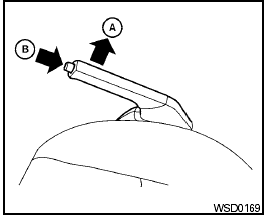
To engage: Pull the lever up A .
To release:
1. Firmly apply the foot brake.
2. Manual transmission models:
Place the shift selector in the N (Neutral) position.
CVT models:
Move the shift selector to the P (Park) position.
3. While pulling up on the parking brake lever slightly, push the button and lower completely B .
4. Before driving, be sure the brake warning light goes out.
See also:
Loading tips
● The GVW must not exceed GVWR
or GAWR as specified on the
F.M.V.S.S./C.M.V.S.S. certification
label.
● Do not load the front and rear axle to
the GAWR. Doing so will exceed the
GVWR ...
Tire and loading information label
Tire and loading information label
1 Seating capacity: The maximum number
of occupants that can be seated
in the vehicle.
2 Vehicle load limit: See “Vehicle loading
information” in the “T ...
Terms
It is important to familiarize yourself with
the following terms before loading your
vehicle.
● Curb Weight (actual weight of your
vehicle) - vehicle weight including.
standard and optio ...