
Important information about this manual
You will see various symbols in this manual. They are used in the following ways:

This is used to indicate the presence of a hazard that could cause death or serious personal injury. To avoid or reduce the risk, the procedures must be followed precisely.

This is used to indicate the presence of a hazard that could cause minor or moderate personal injury or damage to your vehicle. To avoid or reduce the risk, the procedures must be followed carefully.
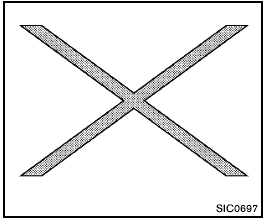
If you see the symbol above, it means “Do not do this” or “Do not let this happen”.

If you see a symbol similar to those above in an illustration, it means the arrow points to the front of the vehicle.

Arrows in an illustration that are similar to those above indicate movement or action.

Arrows in an illustration that are similar to those above call attention to an item in the illustration.
See also:
Operating tips
-When the shift selector is shifted to the R
(Reverse) position, the display screen automatically
changes to the RearView Monitor
mode. However, the radio can be heard.
- It may take some time ...
Passenger compartment
Passenger compartment
1. Rear window defroster switch.
2. Interior trunk lid release.
3. Trunk lid.
4. Vehicle loading.
5. Exterior trunk lid release/request button.
6. Replacing bulbs.
7. Fu ...
Interior
Nissan promises “first-class seating” on sculpted seats. Equipped with either
cloth or leather upholstery, the Murano has flip-out door pockets and a
removable cupholder. Adjustable pedals are ...