
Engine compartment
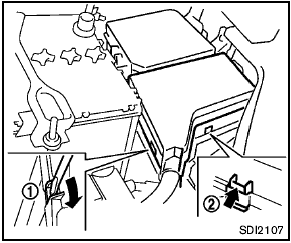

Never use a fuse of a higher or lower amperage rating than that specified on the fuse box cover. This could damage the electrical system or cause a fire.
If any electrical equipment does not operate, check for an open fuse.
1. Be sure the ignition switch and the headlight switch are turned off.
2. Open the engine hood.
3. Remove the air cleaner duct. (See “Engine compartment check locations” earlier in this section.) 4. Remove the fuse/fusible link holder cover using a suitable tool 1 and pushing the tab 2 .
5. Remove the fuse with the fuse puller located in the passenger compartment fuse box.
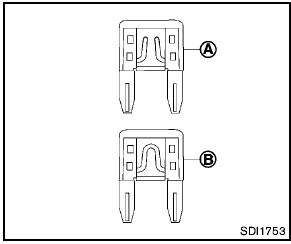
6. If the fuse is open A , replace it with a new fuse B .
7. If a new fuse also opens, have the electrical system checked and repaired by a NISSAN dealer.
Fusible links
If any electrical equipment does not operate and fuses are in good condition, check the fusible links. If any of these fusible links are melted, replace only with genuine NISSAN parts.
See also:
Towing recommended by NISSAN
Towing recommended by NISSAN
NISSAN recommends that your vehicle be towed
with the driving (front) wheels off the ground or
place the vehicle on a flat bed truck as illustrated.
CAUTION:
- ...
Clearing the programmed information
Individual buttons cannot be cleared. However,
to clear all programming, press and hold the two
outside buttons and release when the indicator
light begins to flash (approximately 20 seconds). ...
Octane rating tips
Using unleaded gasoline with an octane
rating lower than recommended can cause
persistent, heavy “spark knock”. (Spark
knock is a metallic rapping noise.) If
severe, this can lead to engin ...