
Towing your vehicle
When towing your vehicle, all State (Provincial in Canada) and local regulations for towing must be followed. Incorrect towing equipment could damage your vehicle. Towing instructions are available from a NISSAN dealer. Local service operators are generally familiar with the applicable laws and procedures for towing. To assure proper towing and to prevent accidental damage to your vehicle, NISSAN recommends having a service operator tow your vehicle. It is advisable to have the service operator carefully read the following precautions:

● Never ride in a vehicle that is being towed.
● Never get under your vehicle after it has been lifted by a tow truck.

● When towing, make sure that the transmission, axles, steering system and powertrain are in working condition. If any of these conditions apply, dollies or a flatbed tow truck must be used.
● Always attach safety chains before towing.
For information about towing your vehicle behind a recreational vehicle (RV), refer to “Flat towing” in the “Technical and consumer information” section of this manual.
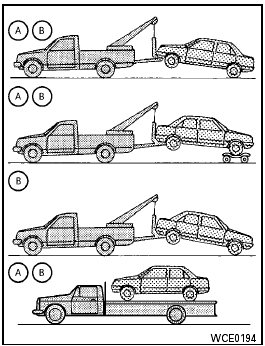
A (CVT) Continuously Variable Transmission
B (M/T) Manual transmission
See also:
Starting the engine
1. Apply the parking brake.
2. Move the shift selector to P (Park) or N
(Neutral). P (Park) is recommended.
The starter is designed not to operate if
the shift selector is in any of the driving ...
g (gravity)-force gauge (if so equipped)
g (gravity)-FORCE GAUGE (if so equipped)
This gauge shows the straight-line acceleration
and deceleration g-forces while you are driving.
NOTE:
The g-force gauge does not indicate cornering ...
NISSAN Intelligent Key™ (if so equipped)
Replace the battery in the Intelligent Key as follows.
1. Remove the mechanical key from the Intelligent
Key.
2. Insert a small screwdriver A into the slit B
of the corner and twist it to sepa ...