
Forward-facing child restraint installation using latch
Refer to all Warnings and Cautions in the Child Safety and Child Restraint sections before installing a child restraint.
Follow these steps to install a forward-facing child restraint using the Latch system:
1. Position the child restraint on the seat. Always follow the child restraint manufacturer s instructions.
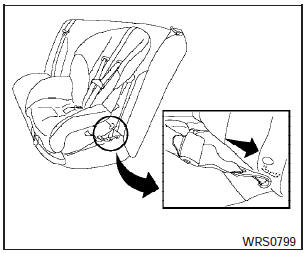
Forward-facing web-mounted step 2
2. Secure the child restraint anchor attachments to the Latch lower anchors. Check to make sure the Latch attachment is properly attached to the lower anchors.
If the child restraint is equipped with a top tether strap, route the top tether strap and secure the tether strap to the tether anchor point. See Installing top tether strap in this section. Do not install child restraints that require the use of a top tether strap in seating positions that do not have a top tether anchor.
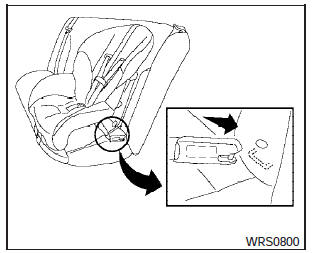
Forward-facing rigid-mounted step 2
3. The back of the child restraint should be secured against the vehicle seatback.
If necessary, adjust or remove the headrest to obtain the correct child restraint fit. If the headrest is removed, store it in a secure place. Be sure to reinstall the headrest when the child restraint is removed.
See Adjustable headrest in this section for headrest adjustment information.
If the seating position does not have an adjustable headrest and it is interfering with the proper child restraint fit, try another seating position or a different child restraint.
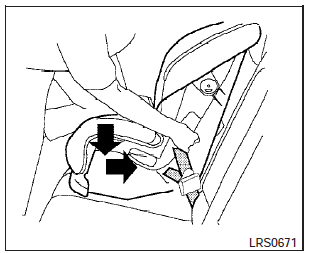
Forward-facing step 4
4. For child restraints that are equipped with webbing-mounted attachments, remove any additional slack from the anchor attachments.
Press downward and rearward firmly in the center of the child restraint with your knee to compress the vehicle seat cushion and seatback while tightening the webbing of the anchor attachments.
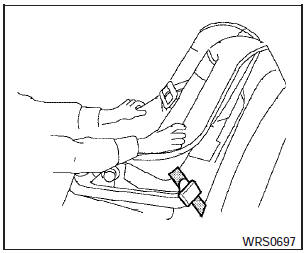
Forward-facing step 5
5. After attaching the child restraint, test it before you place the child in it. Push it from side to side while holding the child restraint near the Latch attachment path. The child restraint should not move more than 1 inch (25 mm), from side to side. Try to tug it forward and check to see if the Latch attachment holds the restraint in place. If the restraint is not secure, tighten the Latch attachment as necessary, or put the restraint in another seat and test it again. You may need to try a different child restraint. Not all child restraints fit in all types of vehicles.
6. Tighten the tether strap according to the manufacturers instructions to remove any slack.
7. Check to make sure the child restraint is properly secured prior to each use. If the child restraint is loose, repeat steps 3 through 5.
See also:
POWER on/off switch
If you have the Type A switch, with the ignition
switch placed in the ACC or ON position, push
the POWER switch to turn the audio system on
or off.
If you have the Type B switch, with the ignit ...
IT'S THE LITTLE THINGS THAT COUNT
Storage Compartments (Puny, Fair, Ample, Galore): Fair
Cargo/Trunk Space (Puny, Fair, Ample, Galore): Puny ...