
Front-seat Active Head Restraints
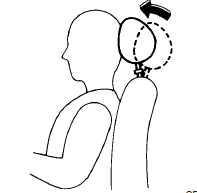
The Active Head Restraint moves forward utilizing the force that the seatback receives from the occupant in a rear-end collision. The movement of the head restraint helps support the occupant’s head by reducing its backward movement and helping absorb some of the forces that may lead to whiplash-type injuries. Active Head Restraints are effective for collisions at low to medium speeds in which it is said that whiplash injury occurs most.
Active Head Restraints operate only in certain rear-end collisions. After the collision, the head restraints return to their original position. Adjust the Active Head Restraints properly as described in this section.
See also:
Next-Generation Efficiency and an All-New V Platform
One of the biggest challenges in designing a compact sedan, of course, is
where to put everything - people, cargo, engine, transmission and other
mechanical components. Often the solution is to ga ...
Freeing a frozen door lock
To prevent a door lock from freezing, apply deicer
through the key hole. If the lock becomes
frozen, heat the key before inserting it into the key
hole or use the remote keyless entry function on
...
Ball mount
The hitch ball is attached to the ball mount and
the ball mount is inserted into the hitch receiver.
Choose a proper class ball mount based on the
trailer weight. Additionally, the ball mount shoul ...