
Xenon headlights (if so equipped)

 HIGH VOLTAGE
- When xenon headlights are on, they produce a high voltage. To prevent an electric shock, never attempt to modify or disassemble. Always have your xenon headlights replaced at a NISSAN dealer.
- Xenon headlights provide considerably more light than conventional headlights. If they are not correctly aimed, they might temporarily blind an oncoming driver or the driver ahead of you and cause a serious accident. If headlights are not aimed correctly, immediately take your vehicle to a NISSAN dealer and have the headlights adjusted correctly.
When the xenon headlight is initially turned on, its brightness or color varies slightly. However, the color and brightness will soon stabilize.
- The life of xenon headlights will be shortened by frequent on-off operation.
It is generally desirable not to turn off the headlights for short intervals (for example, when the vehicle stops at a traffic signal).
- If the xenon headlight bulb is close to burning out, the brightness will drastically decrease, the light will start blinking, or the color of the light will become reddish. If one or more of the above signs appear, contact a NISSAN dealer.
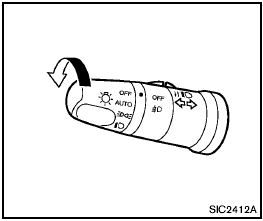
Autolight system (if so equipped)
The autolight system allows the headlights to be set so they turn on and off automatically.
To set the autolight system:
1. Make sure the headlight switch is in the
AUTO position.
2. Turn the ignition switch to the ON position.
3. The autolight system automatically turns the headlights on and off.
To turn the autolight system off, turn the switch
to the OFF,  or
or  position.
The autolight system can turn on the headlights automatically when it is dark and turn off the headlights when it is light.
If the ignition switch is turned to the OFF position and one of the doors is opened and this condition is continued, the headlights remain on for 5 minutes.
Automatic headlights off delay:
You can keep the headlights on for up to 180 seconds after you turn the ignition switch to OFF and open any door then close all the doors.
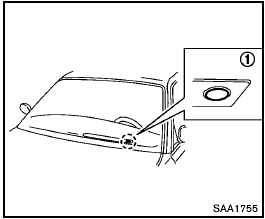
Be sure not to put anything on top of the photo sensor 1 located on the top of the instrument panel. The photo sensor controls the autolight; if it is covered, the photo sensor reacts as if it is dark and the headlights will illuminate.
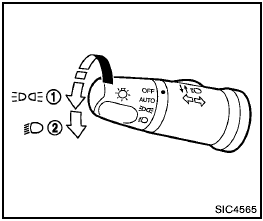
Type A
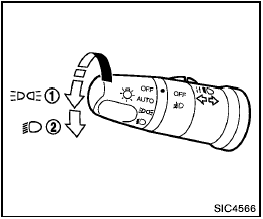
Type B
See also:
In the event of a collision
Unfortunately, accidents do occur. In this unlikely
event, there is some important information you
should know.
Many insurance companies routinely authorize
the use of non-genuine collision par ...
Type A and Type B
Type A-Without compass
Type B-With compass
The indicator light 2 will illuminate when the
automatic anti-glare feature is operating.
To turn off the automatic anti-glare feature, press:
χ ...
How to use remote keyless entry system
How to use remote keyless entry system
1 LOCK button
2 UNLOCK button
3 PANIC button ...