
Head restraints

Head restraints supplement the other vehicle safety systems. They may provide additional protection against injury in certain rear end collisions. Adjust the head restraints properly, as specified in this section. Check the adjustment after someone else uses the seat. Do not attach anything to the head restraint stalks or remove the head restraint. Do not use the seat if the head restraint has been removed. If the head restraint was removed, install and properly adjust the head restraint before an occu- pant uses the seating position. Failure to follow these instructions can reduce the effectiveness of the head restraints.
This may increase the risk of serious injury or death in a collision.
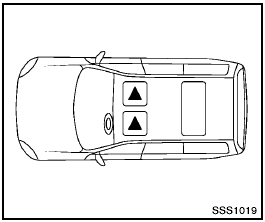
The illustration shows the seating positions equipped with head restraints. The head restraints are adjustable.
 Indicates
the seating position is equipped
with a head restraint.
Indicates
the seating position is equipped
with a head restraint.
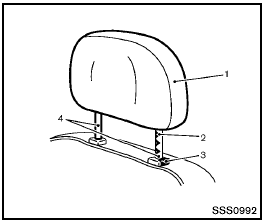
Components
1. Head restraint
2. Adjustment notches
3. Lock knob
4. Stalks
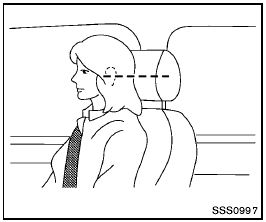
Adjustment
Adjust the head restraint so the center is level with the center of your ears.
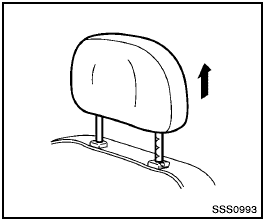
To raise the head restraint, pull it up.
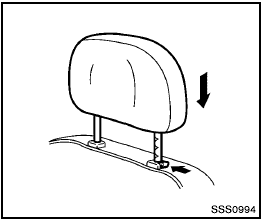
To lower, push and hold the lock knob and push the head restraint down.

Removal
Use the following procedure to remove the adjustable head restraints.
1. Pull the head restraint up to the highest position.
2. Push and hold the lock knob.
3. Remove the head restraint from the seat.
4. Store the head restraint properly in a secure place so it is not loose in the vehicle.
5. Install and properly adjust the head restraint before an occupant uses the seating position.
Install
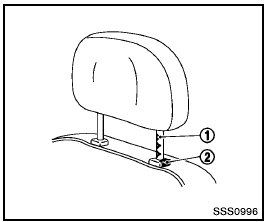
1. Align the head restraint stalks with the holes in the seat. Make sure that the head restraint is facing the correct direction. The stalk with the adjustment notches 1 must be installed in the hole with the lock knob 2 .
2. Push and hold the lock knob and push the head restraint down.
3. Properly adjust the head restraint before an occupant uses the seating position.
Front-seat Active Head Restraints
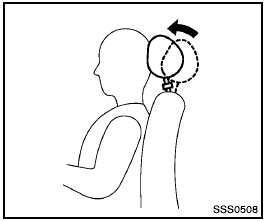
The Active Head Restraint moves forward utilizing the force that the seatback receives from the occupant in a rear-end collision. The movement of the head restraint helps support the occupant’s head by reducing its backward movement and helping absorb some of the forces that may lead to whiplash-type injuries.
Active Head Restraints are effective for collisions at low to medium speeds in which it is said that whiplash injury occurs most.
Active Head Restraints operate only in certain rear-end collisions. After the collision, the head restraints return to their original position.
Adjust the Active Head Restraints properly as described earlier in this section.
See also:
Hitch ball
Choose a hitch ball of the proper size and
weight rating for your trailer:
- The required hitch ball size is stamped on
most trailer couplers. Most hitch balls also
have the size printed on to ...
Relative humidity
Corrosion will be accelerated in areas of high
relative humidity, especially those areas where
the temperatures stay above freezing and where
atmospheric pollution exists and road salt is
used. ...
Tachometer
The tachometer indicates engine speed in revolutions
per minute (rpm). Do not rev engine into
the red zone 1 .
CAUTION
When engine speed approaches the red
zone, shift to a higher gear or reduc ...