
Tire and Loading Information label
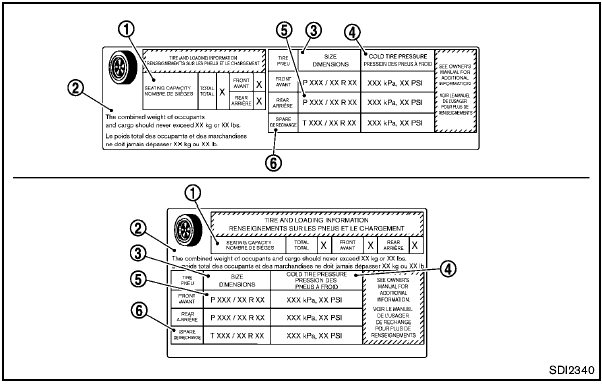
1 Seating capacity: The maximum number of occupants that can be seated in the vehicle.
2 Vehicle load limit: See “Vehicle loading information” in the “9. Technical and consumer information” section.
3 Original size: The size of the tires originally installed on the vehicle at the factory.
4 Cold tire pressure: Inflate the tires to this pressure when the tires are cold.
Tires are considered COLD after the vehicle has been parked for 3 or more hours, or driven less than 1 mile (1.6 km) at moderate speeds. The recommended cold tire inflation is set by the manufacturer to provide the best balance of tire wear, vehicle handling, driveability, tire noise, etc., up to the vehicle’s GVWR.
5 Tire size — see “Tire labeling” later in this section.
6 Spare tire size or compact spare tire size (if so equipped)
See also:
FM/AM radio operation
FM·AM button:
Press the FM·AM button to change the band as
follows.
AM → FM1 → FM2 → AM
If another audio source is playing when the
FM·AM button is pressed, the audio sour ...
Loose Fuel Cap warning message
Loose Fuel Cap warning message
The LOOSE FUEL CAP warning message displays
in the odometer when the fuel-filler cap is
not tightened correctly after the vehicle has been
refueled. It may take ...
Door locks/unlocks precaution
-Do not push the door handle request switch
with the Intelligent Key held in your hand as
illustrated. The close distance to the door
handle will cause the Intelligent Key system
to have dif ...