


Nissan Versa: Safety-Seats, seat belts and supplemental restraint system - Child safety
WARNING
Never allow children to play with or handle the seat belts in your vehicle. Most seating positions inside the Nissan Versa are equipped with an Automatic Locking Retractor (ALR) mode. If a child wraps a seat belt around their neck or body and the ALR mode is inadvertently activated, the belt will lock and continue to retract, tightening around the child. This can result in serious, life-threatening injury or strangulation, and it can occur even when the Nissan Versa is parked and turned off. If a seat belt becomes locked around a child, immediately press the release button to unbuckle it. If the belt cannot be unbuckled or is already unbuckled but remains dangerously tight, quickly free the child by cutting the seat belt webbing with a suitable tool, such as a pair of scissors or a sharp knife.
Children rely entirely on adults for their protection. To ensure their safety during travel, they must be properly and securely restrained in appropriate safety seats at all times.
In addition to the safety guidelines and precautions detailed in this owner's manual, a wealth of child safety information is available from reputable external sources. You can obtain valuable advice from pediatricians, school teachers, government traffic safety administrations, and local community safety organizations.
Because every child is unique in physical build and rate of growth, it is essential to learn and apply the safest methods for transporting your child based on their specific developmental needs.
There are three basic types of child restraint systems designed for vehicles:
- Rear-facing child restraints (designed to cradle and protect infants and young toddlers)
- Forward-facing child restraints (equipped with a multi-point harness for growing children)
- Booster seats (designed to properly position the vehicle's standard seat belt across a child's body)
Choosing the correct restraint system depends primarily on the child's physical size and weight rather than age alone. Generally, newborn infants up to approximately 1 year of age and weighing less than 20 lbs. (9 kg) must be secured in rear-facing child restraints. Forward-facing child restraints are designed for older children who have outgrown the physical limits of their rear-facing seats and are at least 1 year old. Booster seats are utilized to safely elevate and position the standard three-point lap/shoulder seat belt of the Nissan Versa across the skeletal frame of a child who is too large for a forward-facing harness seat but not yet tall enough for the adult belt to fit properly on its own.
WARNING
Infants and young children require specialized safety protection during travel.
The standard seat belts installed in your vehicle are designed for adults and may not fit small children properly. The shoulder belt portion may ride too high, coming dangerously close to their face or neck rather than resting flat across the shoulder.
Likewise, the lap belt portion may sit too high across their soft abdomen instead of fitting snugly over their pelvic bones. In the event of a collision, an improperly positioned seat belt can cause severe, life-threatening internal injuries or fatal trauma. Always utilize an approved and correctly sized child restraint system.
All U.S. states, as well as Canadian provinces and territories, legally mandate the use of officially approved child restraints to secure infants and small children during vehicle operation.
A child safety seat can be installed and secured inside the Nissan Versa cabin by utilizing either the integrated LATCH (Lower Anchors and Tethers for CHildren) system built into the rear seats, or by using the vehicle's standard three-point seat belt system in ALR mode.
NISSAN highly recommends that all pre-teens and children be properly restrained in the rear seats of the vehicle. Real-world accident studies consistently show that children are significantly safer when they are correctly restrained in a rear seating position than when riding in the front passenger seat.
This rear-seat safety rule is particularly critical because your Nissan Versa is equipped with an advanced supplemental restraint system (including dual-stage front air bags) designed to protect adult occupants in the front passenger seat.
Infants
Infants up to at least 1 year of age should always be placed in a high-quality, rear-facing child restraint system to protect their developing neck, head, and spine.
NISSAN recommends utilizing infant car seats that fully comply with all applicable Federal Motor Vehicle Safety Standards (FMVSS) in the United States or Canadian Motor Vehicle Safety Standards (CMVSS) in Canada.
You should select a child safety seat that fits properly within the rear seat dimensions of your Nissan Versa, and you must always follow the child restraint manufacturer's step-by-step instructions for correct installation and safe daily usage.
Small children
Children who are over 1 year of age and weigh at least 20 lbs. (9 kg) should continue to ride in a rear-facing child restraint for as long as possible, up to the maximum height or weight limits specified by the safety seat manufacturer. Once a child outgrows the structural limits of their rear-facing seat and is at least 1 year of old, they should be transitioned to a forward-facing child restraint equipped with a secure five-point harness. Always refer directly to the manufacturer's user guide for specific minimum and maximum height and weight recommendations to ensure your Nissan Versa remains safe for your growing passenger.
NISSAN strongly recommends that all small children be secured in certified child restraints that fully comply with Federal Motor Vehicle Safety Standards (FMVSS) in the United States or Canadian Motor Vehicle Safety Standards (CMVSS) in Canada. It is crucial to choose a high-quality child restraint system that fits perfectly within the specific seat dimensions of your Nissan Versa and to always follow the seat manufacturer's comprehensive instructions for correct installation, routing, and daily usage.
Larger children
Children should continue to ride in a sturdy, forward-facing child restraint equipped with a secure five-point harness until they fully reach the maximum height or weight limit specified by the safety seat manufacturer.
Once a growing child finally outgrows the height or weight limits of a harness-equipped forward-facing child restraint, NISSAN recommends transitioning them to a commercially available booster seat to achieve a safe and proper adult seat belt fit. For the vehicle's seat belt to function effectively, the booster seat must elevate the child so that the shoulder belt is positioned flat across the center of their chest and directly over the top, middle portion of the shoulder. The shoulder belt must never lie across the child's neck or face, nor should it slip off the edge of the shoulder. Additionally, the lap belt must rest snugly and low across the lower hips or upper thighs, never riding up onto the sensitive abdominal area.
A booster seat can only be safely installed in seating positions that are equipped with a standard three-point type lap/shoulder seat belt. When selecting a booster seat for your Nissan Versa, ensure it matches the contours of the vehicle's seats and carries a manufacturer label certifying compliance with either Federal Motor Vehicle Safety Standards or Canadian Motor Vehicle Safety Standards. Once your child has grown tall enough that the shoulder belt naturally rests on the middle of the shoulder without crossing the face or neck, and the lap belt sits low across the lower hips or upper thighs, you can transition to using the standard vehicle seat belt alone without the booster seat.
To ensure maximum safety, a booster seat should be utilized consistently until the child can easily pass all points of the comprehensive seat belt fit test detailed below:
- Can the child sit all the way back with their back and hips resting completely flat against the vehicle seatback?
- Is the child physically able to sit comfortably in this position for the entire trip without slouching or sliding forward?
- Do the child's knees bend naturally and comfortably over the front edge of the seat cushion while their feet remain completely flat on the floor?
- Can the child safely and correctly wear the vehicle's seat belt, keeping the lap belt low and snug across the hip bones and the diagonal shoulder belt positioned across the center of the chest and shoulder?
- Is the child tall enough to safely use the vehicle's properly adjusted integrated or adjustable head restraint/headrest?
- Will the child be disciplined enough to remain properly seated in this correct position for the entire duration of the ride?
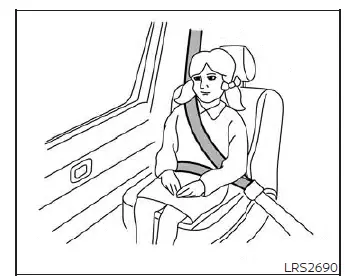
If you answered "no" to even one of these crucial questions, your child is not yet ready for a standard seat belt and should continue to use an approved booster seat paired with the three-point seat belt system in your Nissan Versa.
NOTE: Child occupant safety laws vary by region, and some states, provinces, or municipalities may enforce different age, height, or weight thresholds. Always check local and state regulations to confirm your child is using the legally mandated and correct restraint system before traveling in your Nissan Versa.
WARNING
Never permit a child to stand, kneel, or play on any seat inside the vehicle while it is in motion, and never allow a child to ride in the trunk or rear cargo area under any circumstances. A child who is not properly restrained can be violently thrown around the cabin, leading to serious personal injury or death in the event of a sudden stop, sharp turn, or collision.