


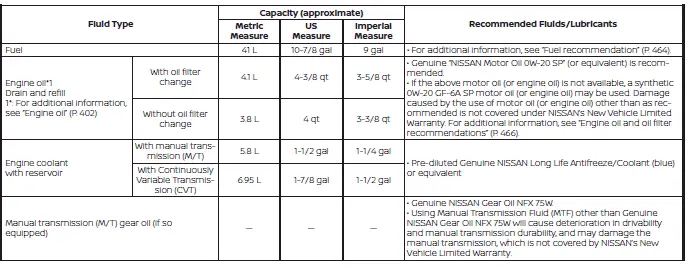
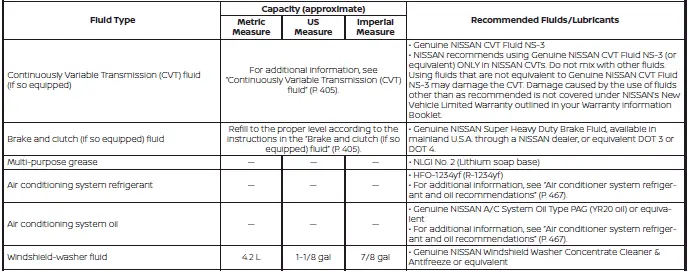
Recommended fluids/lubricants and approximate capacities for your Nissan Versa
The following values represent approximate fluid capacities and lubrication volumes. Actual refill measurements may vary slightly during routine service operations. When refilling systems on your Nissan Versa, always follow the precise measurement and verification procedure described in the "Do-it-yourself" section to determine the exact and proper refill capacity.
Fuel recommendation
Use clean, unleaded regular gasoline with an octane rating of at least 87 AKI (Anti-Knock Index) number, which corresponds to a Research octane number of 91, ensuring optimal combustion and engine efficiency in your Nissan Versa.
CAUTION
- Only vehicles specifically equipped with an E-85 filler door label are certified to operate on E-85 fuel. Severe fuel system component degradation or other serious mechanical damage will occur if E-85 ethanol fuel is utilized in vehicles that are not originally designed or manufactured to run on E-85.
- Using an incorrect fuel type other than that specified for your Nissan Versa could adversely affect the operation of the emission control system, and may also negatively impact your factory warranty coverage.
- Under no circumstances should leaded gasoline be used in your vehicle, because doing so will permanently damage the delicate three-way catalytic converter and exhaust system components.
- Do not use E-15 or E-85 fuel in your vehicle. Your Nissan Versa is not designed or calibrated to run on E-15 or E-85 fuel. Utilizing E-15 or E-85 fuel in a vehicle not specifically engineered for these high-ethanol blends can severely impair the emission control devices and integrated electronic systems of the vehicle. Any resulting damage caused by such improper fuel is explicitly not covered under the NISSAN New Vehicle Limited Warranty.
- Do not use fuel that contains the metallic octane booster additive methylcyclopentadienyl manganese tricarbonyl (MMT).
Using gasoline containing MMT may adversely affect overall vehicle performance and increase harmful vehicle emissions. Not all fuel dispensing stations or pumps are clearly labeled to indicate MMT content, so you may need to consult your local gasoline retailer directly for more details. Note that both Federal and California environmental laws strictly prohibit the use of MMT in reformulated gasoline.
- U.S. government regulations require all commercial ethanol dispensing pumps to be properly identified by a small, square, orange and black label displaying the common chemical abbreviation or the appropriate percentage rate for that specific region.
Gasoline specifications
NISSAN recommends using high-quality gasoline that meets or exceeds the strict World-Wide Fuel Charter (WWFC) specifications wherever it is commercially available. Many of the world's leading automobile manufacturers developed this advanced specification specifically to improve emission control system longevity and overall vehicle performance. Feel free to ask your local service station manager if the gasoline being dispensed meets these WWFC standards.
Reformulated gasoline
Some progressive fuel suppliers are now producing reformulated gasolines. These specialized gasolines are engineered specifically to reduce vehicle tailpipe emissions and minimize environmental impact.
NISSAN fully supports ongoing industry efforts toward cleaner air and suggests that you utilize reformulated gasoline whenever it is accessible in your area.
Gasoline containing oxygenates
Some commercial fuel suppliers sell gasoline containing oxygenating compounds such as ethanol, Methyl Tert-butyl Ether (MTBE), and methanol, with or without explicitly advertising their presence at the pump.
NISSAN strongly advises against the use of commercial fuels where the specific oxygenate content and overall fuel compatibility for your Nissan Versa cannot be readily and accurately determined. If you find yourself in doubt regarding the fuel composition at the pump, always consult your local service station manager for clarification.
If you choose to utilize an oxygenate-blend gasoline in your Nissan Versa, please take the following necessary precautions, as the usage of improper or unverified fuel formulations can cause noticeable vehicle performance problems and/or physical fuel system damage.
- The fuel must be completely unleaded and maintain an octane rating no lower than the minimum level recommended for standard unleaded gasoline.
- If an oxygenate-blend other than a methanol-based blend is selected, it should contain no more than 10% total oxygenate content by volume.
(Methyl Tert-butyl Ether, or MTBE, may, however, be safely added up to a maximum limit of 15%.)
- E-15 fuel contains more than 10% oxygenate content.
E-15 fuel will adversely affect the integrated emission control devices and exhaust systems of your Nissan Versa and should never be used. Any mechanical or system damage caused by such unauthorized fuel is explicitly not covered under the NISSAN New Vehicle Limited Warranty.
- If a methanol blend is used, it should contain no more than 5% methanol (methyl alcohol, commonly known as wood alcohol). It must also contain a suitable and balanced amount of appropriate cosolvents and chemical corrosion inhibitors. If it is not properly formulated with these essential additives, such methanol-heavy blends can cause severe fuel system degradation and/or chronic vehicle performance problems.
At the present time, sufficient industry data is not available to guarantee that all commercial methanol blends are safe and suitable for use in NISSAN vehicles.
If any unexpected driveability problems, such as unexpected engine stalling and difficult hot-starting conditions, are experienced after running on oxygenate-blend fuels, immediately switch over to a standard non-oxygenate fuel or a fuel blend featuring a low concentration of MTBE.
Take careful precautions not to spill any gasoline on exterior surfaces during the refueling process.
Gasoline containing high levels of oxygenates can cause permanent chemical damage to automotive paint finishes.
E-15 fuel
E-15 fuel is commercially defined as a chemical mixture consisting of approximately 15% fuel ethanol and 85% standard unleaded gasoline.
E-15 fuel can only be utilized in vehicles explicitly engineered and certified to run on E-15 fuel. Do not use E-15 fuel in your Nissan Versa. Federal U.S. government regulations require all retail fuel ethanol dispensing pumps to be clearly identified with a small, square, orange and black warning label displaying the common abbreviation or the appropriate percentage rate for that specific geographical region.
E-85 fuel
E-85 fuel is a specialized mixture consisting of approximately 85% fuel ethanol and 15% unleaded gasoline.
E-85 fuel can exclusively be used in a designated Flexible Fuel Vehicle (FFV). Do not use E-85 fuel in your Nissan Versa under any circumstances.
U.S. government regulations mandate that all fuel ethanol dispensing pumps must be properly identified by a small, square, orange and black informational label featuring the common abbreviation or the appropriate percentage for that region.
Fuel containing MMT
MMT, chemically known as methylcyclopentadienyl manganese tricarbonyl, functions as a metallic octane boosting additive.
NISSAN does not recommend the use of any gasoline fuel containing MMT additives. Such formulated fuel may adversely affect overall vehicle performance, including the long-term integrity of the emissions control system. Note that while some commercial fuel pumps explicitly label their MMT content, many do not, meaning you may need to consult your local gasoline retailer directly for more details.
Aftermarket fuel additives
NISSAN does not recommend the use of any commercial aftermarket fuel additives (for example, aftermarket fuel injector cleaners, bottled octane boosters, intake valve deposit removers, and similar chemical treatments) sold in retail stores. Many of these aftermarket additives intended for gum, varnish, or carbon deposit removal contain harsh active solvents or aggressive chemical ingredients that can prove highly harmful to the sensitive fuel system and internal engine components of your Nissan Versa.
Octane rating tips
Using unleaded gasoline with an octane rating lower than recommended can cause persistent, heavy "spark knock." ("Spark knock" is a distinct metallic rapping noise.) If severe, this condition can lead to premature engine damage. If you detect a persistent heavy spark knock in your Nissan Versa even when using gasoline of the correctly stated octane rating, or if you hear steady spark knock while holding a steady cruising speed on level roads, it is recommended that you have an authorized NISSAN dealer inspect and correct the condition. Failure to correct such an abnormal condition is considered misuse of the vehicle, for which NISSAN cannot be held responsible.
Incorrect ignition timing may also result in persistent spark knock, engine after-run, and/or overheating, which may cause excessive fuel consumption or internal engine damage. If any of the above operational symptoms are encountered, have your vehicle checked promptly. It is recommended that you visit an authorized NISSAN dealer for professional servicing.
However, from time to time you may notice light spark knock for a short duration while accelerating hard or driving up steep hills in your Nissan Versa. This is entirely normal and not a cause for concern, because you actually achieve the greatest fuel economy benefit when there is light, transient spark knock for a brief period under heavy engine load.
Engine oil and oil filter recommendations
Selecting the correct oil
It is essential to choose the correct grade, quality, and viscosity engine oil to ensure satisfactory engine life and peak performance in your Nissan Versa.
For additional information, see the section titled "Recommended fluids/lubricants and capacities". NISSAN recommends the regular use of an energy-conserving engine oil in order to improve overall vehicle fuel economy.
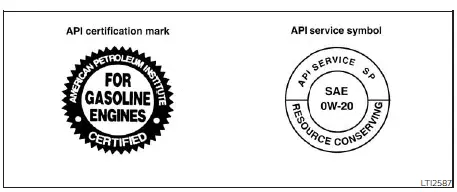
Select only engine oils that meet the strict American Petroleum Institute (API) certification standards or the International Lubricant Standardization and Approval Committee (ILSAC) certification criteria alongside the required SAE viscosity standard.
These approved oils proudly display the official API certification mark on the front of the container. Engine oils which do not feature the specified quality certification label should never be used, as they could cause severe engine damage.
Oil additives
NISSAN does not recommend the use of any aftermarket oil additives. The use of an external oil additive is entirely unnecessary when the proper factory oil type is utilized and regular maintenance intervals are strictly followed.
Engine oil which may contain foreign matter, debris, or has been previously used should never be put into your vehicle.
Oil viscosity
Engine oil viscosity, or thickness, changes naturally with ambient operating temperatures. Because of this property, it is critically important to select the engine oil viscosity based on the anticipated outside temperatures at which your Nissan Versa will be operated before the next scheduled oil change. Choosing an oil viscosity other than that recommended could cause serious engine damage.
Selecting the correct oil filter
Your new Nissan Versa vehicle is equipped from the factory with a high-quality Genuine NISSAN oil filter. When performing routine maintenance replacements, always use a Genuine NISSAN oil filter or its exact equivalent for the critical reasons thoroughly described in the following "Change intervals" section.
Change intervals
The scheduled engine oil and oil filter change intervals for your engine are specifically designed around the regular use of the specified quality oils and approved filters. Utilizing engine oil and replacement filters that fail to meet the specified quality standards, or exceeding the recommended oil and filter change intervals, could significantly reduce overall engine life span. Any mechanical damage to the engine caused by improper maintenance procedures or the use of incorrect oil and filter quality and/or viscosity is explicitly not covered under the NISSAN New Vehicle Limited Warranty.
Your Nissan Versa engine was originally filled with a high-quality factory engine oil when it was built. You do not need to change the oil prematurely before reaching the first recommended change interval. Total oil and filter change intervals depend largely upon the specific conditions under which you operate your vehicle.
Regular vehicle operation under any of the following demanding conditions may require much more frequent engine oil and filter changes:
- repeated short distance driving trips at cold outside ambient temperatures
- frequent driving in dusty, sandy, or unpaved conditions
- extensive periods of vehicle idling in traffic
- heavy stop-and-go urban commuting
For additional detailed information regarding severe use conditions, refer to the "Maintenance and schedules" section of this manual.
Air conditioner system refrigerant and oil recommendations
The climate control air conditioner system in your Nissan Versa vehicle must be charged exclusively with the specified refrigerant HFO-1234yf (R-1234yf) and NISSAN A/C system oil Type PAG (YR20 oil) or their exact verified equivalents.
CAUTION
The unauthorized use of any other refrigerant type or system oil will cause severe, irreversible damage to the entire air conditioning system and will require the complete replacement of all air conditioner system components.
The eco-friendly refrigerant HFO-1234yf (R-1234yf) utilized in your Nissan Versa vehicle does not harm the earth's ozone layer. Although this advanced refrigerant does not negatively affect the upper atmosphere, strict government environmental regulations require the professional recovery and recycling of any refrigerant during any automotive air conditioner system service procedure. The air conditioner system on your Nissan Versa should only be serviced by trained and certified automotive technicians to ensure proper and safe system operation (SAE J2845). An authorized NISSAN dealer has the specially trained technicians and advanced equipment needed to correctly recover and recycle your air conditioner system refrigerant. Only brand new and SAE J2842 certified evaporator units shall be used as authorized replacement parts.
A damaged or leaking air conditioning evaporator shall never under any circumstances be repaired or replaced with a component removed from a used or salvaged vehicle. To properly replace a damaged or leaking evaporator in your Nissan Versa, use only new and SAE J2842 certified evaporator parts. It is highly recommended that you visit an authorized NISSAN dealer whenever servicing your vehicle's air conditioner system.