



Nissan Versa: Monitor, climate, audio, phone and voice recognition systems - Automatic Emergency Braking (AEB) with Pedestrian Detection
WARNING
Failure to follow these critical safety warnings and instructions for the proper use of the AEB with Pedestrian Detection system on your Nissan Versa could result in serious personal injury or a fatal accident.
- The AEB with Pedestrian Detection system functions purely as a supplemental driving aid to the driver. It is never a replacement for the driver's continuous attention to changing traffic conditions or their fundamental responsibility to drive safely.
The system cannot prevent accidents caused by operator carelessness, distractions, or dangerous driving techniques.
- The AEB with Pedestrian Detection system does not operate under all conceivable driving, traffic, weather, and road conditions.
The advanced AEB with Pedestrian Detection system can assist the driver of your Nissan Versa whenever there is an emerging risk of a forward collision with another vehicle traveling ahead in the same lane or with a pedestrian crossing ahead in your path.
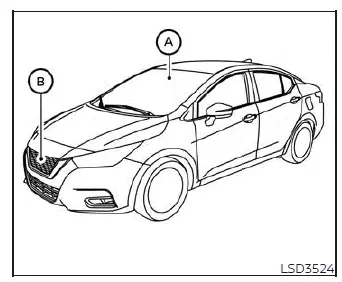
The AEB with Pedestrian Detection system utilizes a front-facing radar sensor located on the front of the vehicle B to accurately measure the distance to any vehicle ahead in the same lane. For pedestrian monitoring, the system integrates a high-resolution camera installed securely behind the windshield OA in addition to the primary front radar sensor.
- AEB with Pedestrian Detection system operation
- Turning the AEB with Pedestrian Detection system on/off
- AEB with Pedestrian Detection system limitations
- System temporarily unavailable
AEB with Pedestrian Detection system operation Nissan Versa 2026
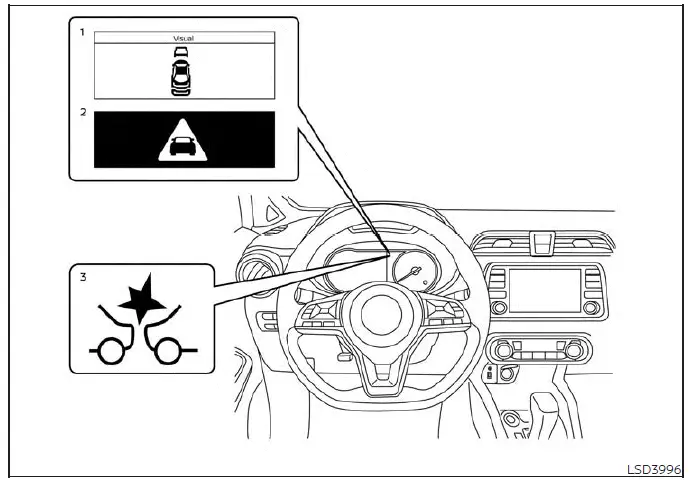
Vehicle Information Display
- Vehicle ahead detection indicator (if so equipped)
- AEB with Pedestrian Detection emergency warning indicator (if so equipped)
- AEB with Pedestrian Detection system warning light
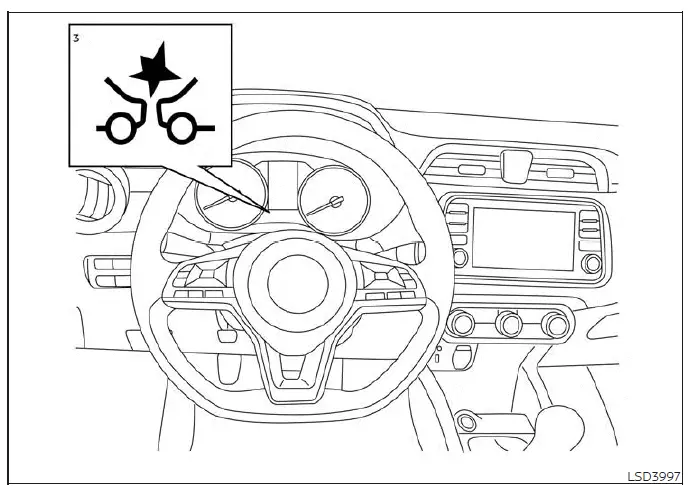
Trip Computer
The core AEB vehicle braking system operates dynamically at speeds above approximately 3 mph (5 km/h). For the dedicated pedestrian detection function, the system operates effectively at vehicle speeds ranging between 6 and 37 mph (10 and 60 km/h).
If a potential risk of a forward collision is detected, the AEB with Pedestrian Detection system will first provide an early warning to the driver by flashing the vehicle ahead detection indicator (in yellow) directly within the vehicle information display (if so equipped) while sounding an audible alert tone. If the driver applies the brakes quickly and forcefully right after this initial warning, and the system senses that a forward collision possibility still remains, the system will automatically boost and increase the braking force.
If the driver fails to take immediate action, the AEB with Pedestrian Detection system issues a secondary visual warning flashing in red and white on the vehicle information display screen (if so equipped) accompanied by a stronger audible warning. If the driver lifts their foot off the accelerator pedal, the system will apply partial braking. If the risk of a collision escalates and becomes imminent, the AEB with Pedestrian Detection system will automatically apply harder, maximum emergency braking.
While the AEB with Pedestrian Detection system is actively operating, you may hear a mechanical noise coming from the brakes. This is completely normal and confirms that the AEB with Pedestrian Detection system is functioning properly.
NOTE:
The exterior brake lights of your Nissan Versa will automatically illuminate whenever any level of braking is performed by the AEB with Pedestrian Detection system.
Depending on your current vehicle speed, the exact distance to the lead vehicle or pedestrian ahead, and prevailing roadway conditions, the system may help the driver completely avoid a forward collision or help significantly mitigate the severity of consequences if an impact becomes unavoidable.
If the driver is actively steering, accelerating, or braking manually, the AEB with Pedestrian Detection system will intervene later or may not trigger at all.
The automatic braking intervention will cease immediately under any of the following conditions:
- When the steering wheel is turned sharply to maneuver around and avoid a collision.
- When the accelerator pedal is actively depressed by the driver.
- When there is no longer a vehicle or pedestrian detected ahead in your path.
If the AEB with Pedestrian Detection system has brought your Nissan Versa to a complete stop, the vehicle will remain held at a standstill for approximately 2 seconds before the automated brakes are automatically released.
Turning the AEB with Pedestrian Detection system on/off Nissan Versa third generation
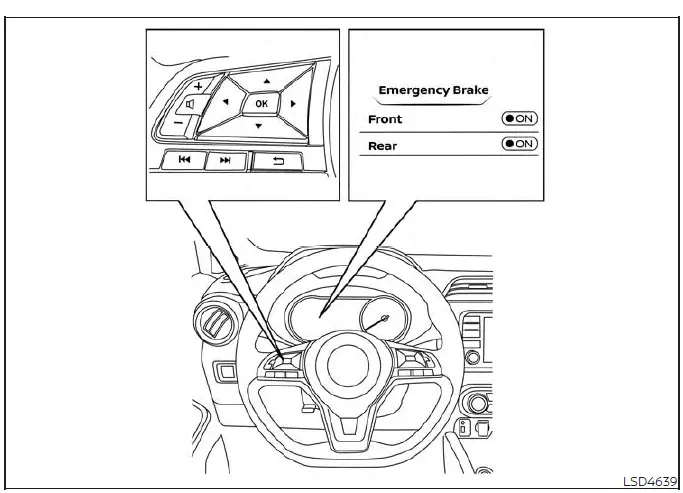
Perform the following simple sequential steps whenever you need to enable or disable the advanced AEB with Pedestrian Detection system on your Nissan Versa.
For vehicles equipped with the vehicle information display:
1. Press the
 control button repeatedly until "Settings" is clearly shown in the vehicle information display.
Use the
 button to highlight and select "Driver Assistance." Then press the OK confirmation button.
2. Select the "Emergency Brake" menu option and press the OK button.
3. Select "Front" and press the OK button to toggle the system either on or off according to your preference.
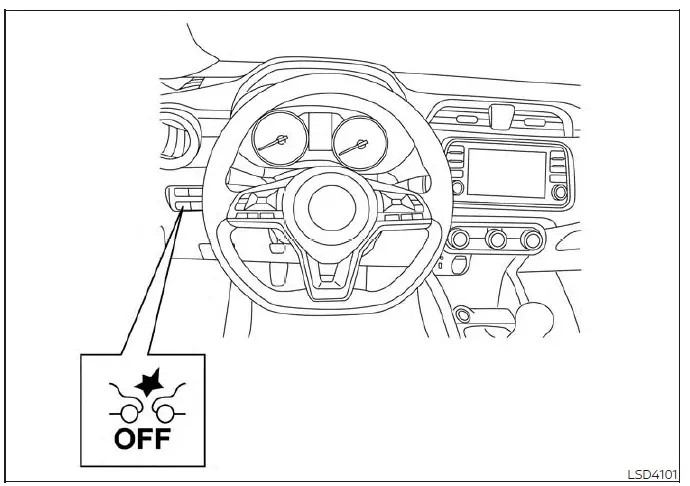
For vehicles equipped with the AEB with Pedestrian Detection OFF switch:
1. The AEB with Pedestrian Detection system is enabled automatically every time the vehicle engine starts.
2. Push and hold the physical AEB with Pedestrian Detection OFF switch down for approximately 3 seconds to turn the system either OFF or back ON.
When the AEB with Pedestrian Detection system is successfully turned off, the dedicated system warning light will illuminate on the dashboard instrument cluster.
NOTE:
- The AEB with Pedestrian Detection system will be automatically re-enabled and turned back on whenever the vehicle engine is restarted.
- If the AEB with Pedestrian Detection system is turned off using the physical AEB OFF switch, the complementary Rear Automatic Braking (RAB) system will also be turned off simultaneously.
- The Intelligent Forward Collision Warning (I-FCW) system is integrated directly into the core AEB with Pedestrian Detection system architecture.
There is no separate individual menu selection in the vehicle information display for the I-FCW system alone. When the main AEB system is turned off, the I-FCW system is also turned off at the same time.
AEB with Pedestrian Detection system limitations Nissan Versa 2026
WARNING
Listed below are the comprehensive operational system limitations for the advanced Automatic Emergency Braking with Pedestrian Detection system on your Nissan Versa. Failure to operate your vehicle in strict accordance with these crucial system limitations could result in serious personal injury or a fatal accident.
- Please understand that the AEB with Pedestrian Detection system cannot reliably detect all vehicles, objects, or pedestrians under every conceivable driving condition.
- The AEB with Pedestrian Detection system does not detect or respond to the following entities:
- Pedestrians who are small in stature (for example, young children), in a sitting or crouching position, operating toys, skateboards, or scooters, riding in wheelchairs, or not maintaining an upright standing or walking posture.
- Animals of any size or shape crossing your path.
- Random obstacles (such as loose cargo, debris, or fallen objects) lying directly on the roadway or along the roadside.
- Oncoming traffic or vehicles crossing perpendicularly.
- Vehicles where the tires are difficult to distinguish or where the overall profile and shape of the rear end are unclear, obscured, or modified.
- Stationary parked vehicles under certain non-ideal conditions.
- The AEB with Pedestrian Detection system is subject to specific design performance limitations.
- If a stationary vehicle is directly in your Nissan Versa's forward path, the system will not function or intervene when your vehicle approaches the stationary target at speeds exceeding approximately 50 mph (80 km/h).
- Pedestrian detection will not function when the vehicle is driven at speeds exceeding approximately 37 mph (60 km/h) or traveling below approximately 6 mph (10 km/h).
- The AEB with Pedestrian Detection system may fail to function properly or may struggle to detect a vehicle or pedestrian ahead under the following adverse conditions:
- During poor visibility scenarios (such as heavy rain, falling snow, dense fog, swirling dust storms, sandstorms, thick smoke, or heavy road spray kicked up by preceding vehicles).
- If dirt, mud, ice, packed snow, heavy condensation, or other materials are covering the front radar sensor area or the windshield camera housing.
- If harsh, blinding light (for example, glaring direct sunlight or oncoming high-beam headlights) floods the front camera, or if there is a sudden, extreme change in ambient brightness (such as entering a dark tunnel or driving amidst flashing lightning).
- In dark, unlit, or dimly lit environments—such as driving at night or navigating long tunnels—including situations where your vehicle's headlights are turned off or dimmed, or where the tail lights of the vehicle ahead are unilluminated or broken.
- When the physical mounting direction or angle of the forward camera is misaligned.
- When driving down a steep downhill grade, navigating sharp roadway curves, or traveling over rough, bumpy, or unpaved dirt roads.
- If there is severe electronic or radio frequency interference caused by external radar sources.
- When your Nissan Versa's physical position or movement changes abruptly or significantly (for example, during sudden lane changes, turning maneuvers, aggressive steering inputs, or sudden acceleration and deceleration).
- When your vehicle, or the vehicle/pedestrian ahead, moves so quickly or erratically that the system cannot process and react in time (for example, a pedestrian darting toward the vehicle at close range, or another vehicle cutting in, changing lanes, or braking violently).
- When the target vehicle or pedestrian is offset from your direct forward travel path.
- If the speed differential between your vehicle and the vehicle ahead is minimal.
- When a pedestrian's physical profile is partially obscured, hidden, or unidentifiable; for example, due to carrying large luggage, pushing a stroller, wearing bulky, thick, or extremely loose-fitting clothing and accessories, or maintaining an unusual posture (such as raising arms).
- When there is poor visual contrast between a person and their surrounding background, such as wearing clothing colors or patterns that closely match the environmental backdrop.
- During the initial warm-up period lasting approximately 15 seconds immediately after starting the engine.
- If the vehicle ahead features a unique or unusual body shape, extremely low or high ground clearance heights, bizarre cargo loading configurations, or an exceptionally narrow profile (such as a motorcycle or bicycle).
- When a vehicle or pedestrian is positioned directly near a bright traffic sign, a highly reflective surface (such as standing water on the road), or is hidden deep within a shadow.
- When multiple pedestrians are clustered closely together in a group.
- When the line of sight to a pedestrian is physically blocked by an intervening vehicle or large object.
- Overall system performance may become significantly degraded under the following operational conditions:
- When the vehicle is driven on an extremely slippery, icy road.
- When the vehicle is driven on a steep slope or incline.
- When excessively heavy baggage, cargo, or passengers are loaded into the rear seat or trunk area of your vehicle, altering its ride height.
- The system is engineered to automatically check the functional integrity of its sensors (both radar and camera) within certain operational boundaries. However, the system may fail to detect certain types of physical obstructions blocking the sensor face, such as thin layers of ice, wet snow, or adhesive stickers. In these instances, the system may be unable to warn the driver properly. Always ensure you visually check, clean, and clear all sensor areas regularly.
- Under certain complex road and traffic environments, the AEB with Pedestrian Detection system may unexpectedly apply partial braking. Whenever active acceleration is required by the driver, firmly depress the accelerator pedal to override the system.
- The system may occasionally operate and trigger when it detects surface patterns, roadside objects, moving shadows, or stray lights that closely mimic the silhouette of vehicles or pedestrians, or if they match the precise size and position profile of a vehicle or motorcycle tail light.
- The system may continue operating and tracking even when a vehicle directly ahead is executing a left or right turn.
- The system may activate when your vehicle is approaching and passing a vehicle traveling ahead in an adjacent lane.
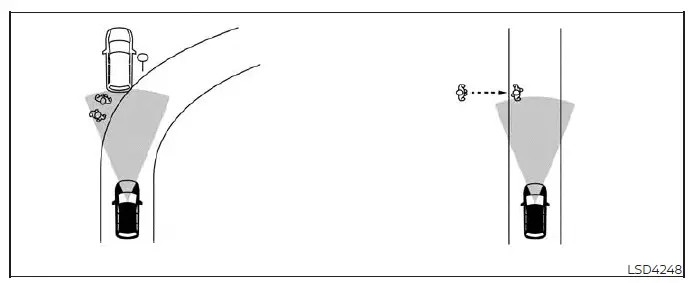
- Depending on the geometry of the road (such as sharp curved roads, the entrance and exit points of a curve, winding mountain passes, active lane regulations, or road construction zones), the system may temporarily and falsely react to an oncoming vehicle positioned in front of your vehicle.
WARNING
Listed below are further critical system limitations for the advanced Automatic Emergency Braking with Pedestrian Detection system on your Nissan Versa. Failure to operate your vehicle in strict accordance with these system limitations could result in serious personal injury or a fatal accident.
- Please be aware that the AEB with Pedestrian Detection system may occasionally react inappropriately or trigger false interventions when encountering the following scenarios:
- Stationary or moving objects situated along the roadside (such as roadside traffic signs, metal guardrails, pedestrians, motorcycles, or parked vehicles)
- Pedestrians present when driving through narrow alleys, tight urban spaces, or restricted passages
- Pedestrians who temporarily protrude into or step close to your driving lane while attempting to maneuver around obstacles located on the road shoulder
- Overhead objects suspended directly above the roadway (such as low-hanging bridges, overhead directional signs, or banners)
- Metallic or structured objects embedded directly into the road surface (such as railroad tracks, drainage grates, or heavy steel construction plates)
- Structural elements inside enclosed parking garages (such as concrete support beams, pillars, or low ceilings)
- Pedestrians or motorcycles moving or stepping close to your traveling lane
- Vehicles, pedestrians, motorcycles, or general objects located in adjacent driving lanes or positioned extremely close to the sides of your vehicle
- Oncoming pedestrians walking toward your vehicle's path
- Objects extending over or onto the road surface, such as low-hanging tree branches
-
Always keep in mind that vehicle stopping and braking distances will increase significantly when driving on slippery, wet, icy, or snow-covered road surfaces.
-
Excessive interior cabin noise—such as having your audio system turned up to high volumes or driving with windows rolled down—will strongly interfere with the audible warning chime sound, meaning the safety chime may not be heard in time by the driver of your Nissan Versa.
System temporarily unavailable Nissan Versa 2020
Vehicle Information Display
Trip Computer
Condition A:
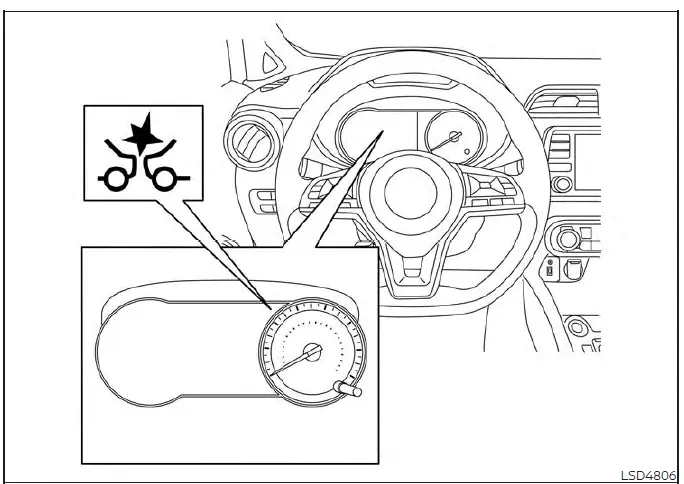
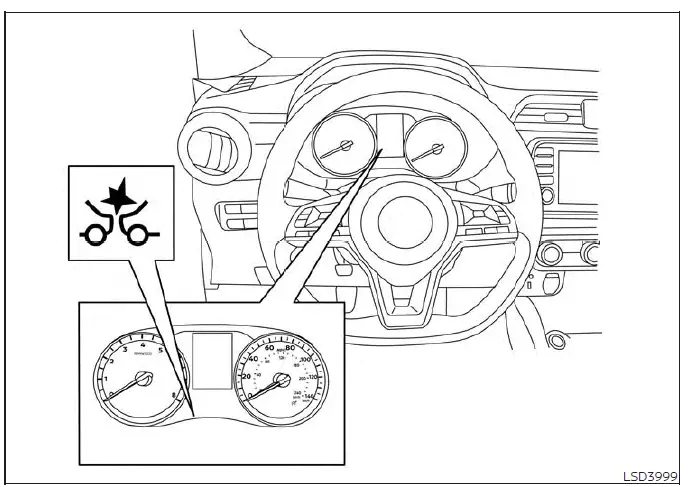
Under the following operational circumstances, the advanced AEB with Pedestrian Detection system warning light will begin to blink, and the safety system will be turned off automatically:
- When the front radar sensor picks up environmental interference or frequency signals from another external radar source.
- When the upper camera area of the windshield glass becomes misted, frosted, or iced over.
- When harsh, blinding strong light is shining directly into the front camera.
- When the interior cabin temperature rises over approximately 104ºF (40ºC) while parked directly under intense sunlight.
- When the camera viewing area on the windshield glass is continuously covered with thick dirt, mud, or grime.
Action to take:
As soon as the above adverse conditions no longer exist, the AEB with Pedestrian Detection system on your Nissan Versa will resume normal operation automatically.
NOTE:
When the inner surface of the windshield around the camera area is misted or frozen, it will naturally take a short period of time to clear after the climate control A/C system is turned on. If stubborn dirt appears on this glass area, it is recommended that you visit an authorized NISSAN dealer.
Condition B:
When the front radar sensor mounted on the front bumper is thickly covered with road dirt, snow, or obstructed by debris, the AEB system will be automatically canceled.
An audible warning chime will sound and the "Unavailable: Front Radar Obstruction" warning message will appear directly within the vehicle information display (if so equipped).
Action to take:
If this warning message appears, safely pull over and stop your Nissan Versa in a secure place, place the transmission shift lever into the P (Park) position, and turn the engine off. When the radar signal is temporarily interrupted by foreign matter, carefully clean the sensor area of the front bumper and restart the engine. If the "Unavailable: Front Radar Obstruction" warning message continues to be displayed in the vehicle information display (if so equipped), you should have the system professionally checked. It is recommended that you visit an authorized NISSAN dealer for this service.
Condition C:
When driving your vehicle across roads with sparse or limited surrounding road structures or prominent buildings (for example, driving across long open bridges, vast deserts, snowy white plains, or traveling next to long continuous sound barrier walls), the system may illuminate the system warning light and display the "Unavailable: Front Radar Obstruction" message in the vehicle information display (if so equipped).
Action to take:
When you have cleared these unique driving conditions and normal roadway environments return, turn the safety system back on.
Condition D:
When the Vehicle Dynamic Control (VDC) system is manually turned OFF, the automated braking functionality of the AEB with Pedestrian Detection system will not operate.
In this specific situation, only the visible and audible warnings will operate. The dedicated AEB with Pedestrian Detection system warning light will illuminate.
Action to take:
Once the VDC system is switched back ON, the AEB with Pedestrian Detection system will resume its normal functions automatically.
NOTE:
If the AEB with Pedestrian Detection system stops working for any reason, the complementary Intelligent Forward Collision Warning (I-FCW) system will also stop working simultaneously.
System malfunction
If the AEB with Pedestrian Detection system on your Nissan Versa experiences an internal technical malfunction, it will be turned off automatically, an audible chime will sound, the orange AEB with Pedestrian Detection system warning light will illuminate, and the [Malfunction] warning message will appear in the vehicle information display (if so equipped).
Action to take
If this orange warning light comes on, safely pull over and stop your vehicle in a secure location, turn the engine off completely, and then restart the engine. If the warning light continues to illuminate persistently, have the AEB with Pedestrian Detection system checked. It is recommended that you visit an authorized NISSAN dealer for this professional service.
System maintenance
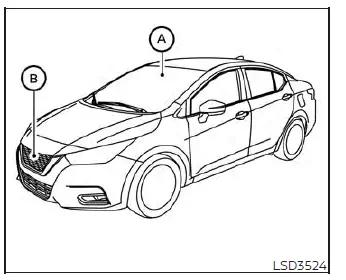
The primary radar sensor is located on the front of the vehicle B, while the optical camera is positioned on the upper interior side of the windshield A.
To keep the AEB with Pedestrian Detection system on your Nissan Versa operating properly and reliably, be sure to observe and follow these maintenance guidelines:
- Always keep the designated sensor areas of the front bumper and windshield impeccably clean.
- Do not strike, knock, or physically damage the structural areas surrounding the sensors (such as the front bumper fascia or windshield glass).
- Do not cover the sensors, attach adhesive stickers, or install any aftermarket accessories near the sensor units. This could block vital sensor signals and cause performance failure or system malfunction.
- Do not attach metallic objects or heavy accessories near the radar sensor area (such as a brush guard, custom grille trim, etc.). This could cause complete system failure or erratic malfunction.
- Do not place highly reflective materials, such as a sheet of white paper or a mirror, on top of the instrument panel dashboard. The intense reflection of sunlight may adversely affect the optical camera unit's detection capability.
- Do not alter, remove, or paint over the front bumper. Before customizing or restoring the front bumper of your Nissan Versa, it is strongly recommended that you visit an authorized NISSAN dealer.
Radio frequency statement
For USA
Radiofrequency radiation exposure Information:
This equipment complies with FCC radiation exposure limits set forth for an uncontrolled environment. This equipment should be installed and operated with minimum distance of 30 cm between the radiator and your body. The transmitter must not be co-located or operating in conjunction with any other antenna or transmitter.
FCC Notice:
Changes or modifications not expressly approved by the party responsible for compliance could void the user's authority to operate the equipment.
For Canada
This device complies with Part 15 of the FCC Rules and with Industry Canada licence-exempt RSS standard(s). Operation is subject to the following two conditions:
1. This device may not cause interference, and
2. This device must accept any interference received, including interference that may cause undesired operation of the device.
Le présent appareil est conforme aux CNR d'Industrie Canada applicables aux appareils radio exempts de licence.
L'exploitation est autorisée aux deux conditions suivantes:
1. L'appareil ne doit pas produire de brouillage, et
2. L'utilisateur de l'appareil doit accepter tout brouillage radioélectrique subi, même si le brouillage est susceptible d'en compromettre le fonctionnement.
Radio frequency radiation exposure information:
This equipment complies with FCC and IC radiation exposure limits set forth for an uncontrolled environment.
This equipment should be installed and operated with minimum distance of 30 cm between the radiator and your body.
This transmitter must not be co-located or operating in conjunction with any other antenna or transmitter.
Cet équipement est conforme aux limites d'exposition aux rayonnements IC établies pour un environnement non contrôlé.
Cet équipement doit être installé et utilisé avec un minimum de 30 cm de distance entre la source de rayonnement et votre corps.
FCC Notice
Changes or modifications not expressly approved by the party responsible for compliance could void the user's authority to operate the equipment.