


Nissan Versa: Do-it-yourself - Wheels and tires
Tire pressure Nissan Versa sedan
Tire Pressure Monitoring System (TPMS)
WARNING
Radio frequency waves emitted by vehicle systems could adversely affect the operation of sensitive electric medical equipment.
Individuals who utilize an implanted pacemaker or similar medical device should contact the electric medical equipment manufacturer directly for detailed guidance regarding possible electromagnetic influences before operating or riding in the vehicle.
Your Nissan Versa is equipped with an advanced Tire Pressure Monitoring System (TPMS) designed to enhance driving safety.
This intelligent system actively monitors the inflation pressure of all four main road tires, excluding the spare tire. When the low tire pressure warning light illuminates on the dashboard and the warning message reading "Tire Pressure Low - Add Air" appears clearly in the vehicle information display screen, it indicates that one or more of your tires is significantly under-inflated.
Please note that the TPMS will activate and begin monitoring only when the vehicle is driven at speeds above 16 mph (25 km/h). Furthermore, drivers should be aware that this electronic system may not immediately detect a sudden, catastrophic drop in tire pressure, such as a sudden blowout or flat tire while driving at high speed.
Tire inflation pressure
Check the inflation pressures of all tires, including the spare tire, frequently and always prior to embarking on long-distance road trips. The precise recommended cold tire pressure specifications for your Nissan Versa are clearly listed on the official F.M.V.S.S./C.M.V.S.S. vehicle certification label or on the dedicated Tire and Loading Information label located under the "Cold Tire Pressure" heading. The Tire and Loading Information label is affixed securely to the driver's side center door pillar.
Vehicle tire pressures should be checked on a regular basis for several key reasons:
- Most pneumatic tires naturally lose a small amount of compressed air over time through normal permeation.
- Tires can lose air pressure suddenly and unexpectedly when driven aggressively over deep potholes or other road hazards, or if the vehicle wheel strikes a curb sharply while parallel parking or maneuvering.
Accurate tire pressures should always be checked and adjusted when the tires are cold. Tires are officially considered COLD after the vehicle has been parked for 3 or more consecutive hours, or driven for a distance of less than 1 mile (1.6 km) at moderate, low-speed city rates.
Additionally, your Nissan Versa may feature the convenient TPMS with Easy-Fill Tire Alert system, which provides helpful visual exterior light flashes and audible horn signals outside the vehicle to guide you when inflating your tires to the recommended COLD tire pressure level.
Incorrect tire pressure, including chronic under-inflation, may adversely affect overall tire tread life span and compromise vehicle handling performance.
WARNING
- Improperly inflated tires can experience excessive internal heat buildup, fail suddenly without warning, and cause a dangerous loss of vehicle control resulting in an accident.
- The official Gross Vehicle Weight Rating (GVWR) specification is located on the F.M.V.S.S./C.M.V.S.S. vehicle certification label. The maximum allowable vehicle weight carrying capacity is clearly indicated on the Tire and Loading Information label.
Never load your Nissan Versa beyond this specified weight capacity limit. Overloading your vehicle may result in significantly reduced tire life, unsafe driving conditions due to premature structural tire failure, or unstable handling characteristics, and could ultimately lead to a serious accident. Exceeding the specified weight capacity may also result in mechanical failure or damage to other critical vehicle suspension and braking components.
- Before taking a long-distance road trip, or whenever you load your vehicle heavily with passengers and cargo, always use a reliable, calibrated tire pressure gauge to ensure that all tire pressures are maintained at the specified manufacturer level.
- For comprehensive additional information regarding tire care and safety, refer to the "Important Tire Safety Information" (for US models) or "Tire Safety Information" (for Canadian models) sections found inside your official Warranty Information Booklet.
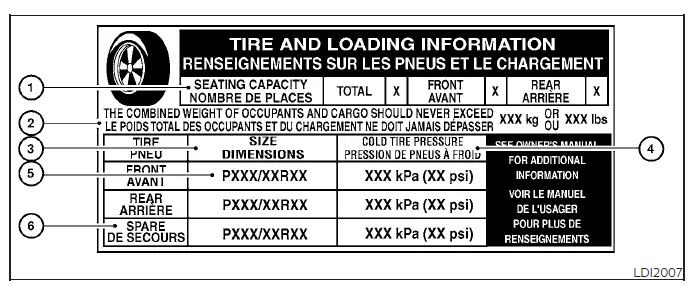
Tire and Loading Information label
- Seating capacity: The maximum total number of vehicle occupants that can be safely seated inside your Nissan Versa.
- Vehicle load limit: For comprehensive additional information regarding weight limits, see the dedicated section titled "Vehicle loading information".
- Tire size: For details on sizing specifications, see the section titled "Tire labeling".
- Cold tire pressure: Inflate all tires precisely to this specified pressure level when the tires are cold. Tires are officially considered COLD after your Nissan Versa has been parked for 3 or more consecutive hours, or driven less than 1 mile (1.6 km) at moderate, low city speeds. The recommended cold tire inflation pressure is carefully calibrated by the manufacturer to provide the optimal balance of uniform tire wear, stable vehicle handling, refined driveability, minimized road tire noise, and overall safety up to the vehicle's maximum Gross Vehicle Weight Rating (GVWR).
- Original tire size: The exact factory specification size of the pneumatic tires originally installed on the vehicle at the assembly plant.
- Spare tire size: The specific dimensions and specification of the emergency or regular spare tire included with your vehicle.
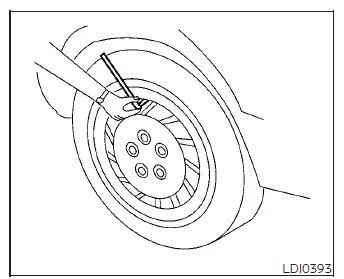
Checking tire pressure
1. Unscrew and remove the protective valve stem cap from the tire air valve.
2. Firmly press a reliable tire pressure gauge squarely and straight onto the tire valve stem. Take care not to press down with excessive force or push the valve stem sideways at an angle, as this will unseat the valve core and cause compressed air to escape.
If you hear an audible hissing sound of air leaking out of the tire while attempting to check the pressure, immediately reposition or adjust the angle of the gauge to eliminate this air leakage.
3. Remove the pressure gauge cleanly from the valve.
4. Read the measured tire pressure value indicated on the gauge stem and compare it directly to the official specification shown on your Nissan Versa Tire and Loading Information label.
5. Add compressed air to the tire using an air compressor as needed. If you accidentally inflate the tire too much and the pressure is too high, press the center core pin of the valve stem briefly with the tip of the gauge stem or a small tool to bleed out excess air pressure. Recheck the pressure reading and add or release air iteratively until the correct level is reached.
6. Reinstall the protective valve stem cap securely by hand.
7. Repeat this entire pressure-checking and adjustment process for all other road tires on your Nissan Versa, including the spare tire.
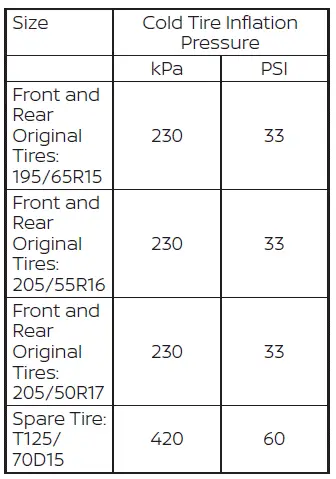
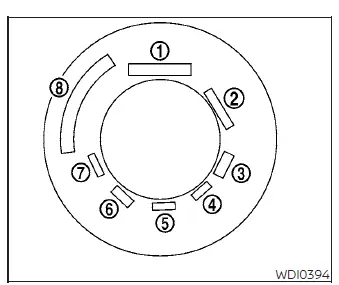
Example
Tire labeling Nissan Versa third generation
Federal regulations and laws require all tire manufacturers to place standardized informational markings directly on the sidewall of every tire produced.
This vital information clearly identifies and describes the fundamental structural characteristics of the tire and also provides the unique Tire Identification Number (TIN) required for safety standard certification. This TIN code can be used to quickly identify and track the tire in the event of a manufacturer safety recall affecting your Nissan Versa.
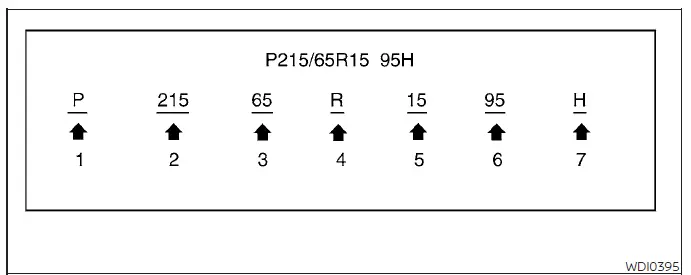
Example
- Tire size (example: P215/65R15 95H)
1. P: The prefix letter "P" indicates that the tire is specifically designed for passenger vehicles, though please note that not all tires feature this designation.
2. Three-digit number (215): This numerical value represents the nominal width of the tire measured in millimeters from sidewall edge to sidewall edge.
3. Two-digit number (65): This value, commonly known as the aspect ratio, specifies the tire's height-to-width percentage ratio.
4. R: The letter "R" stands for radial construction.
5. Two-digit number (15): This number indicates the corresponding wheel or rim diameter size measured in inches.
6. Two- or three-digit number (95): This code represents the tire's load index rating.
It serves as a standard measurement indicating the maximum weight load capacity that each individual tire can safely support.
7. H: The tire speed rating letter. You should never operate your Nissan Versa at speeds exceeding the maximum threshold established by the tire speed rating.
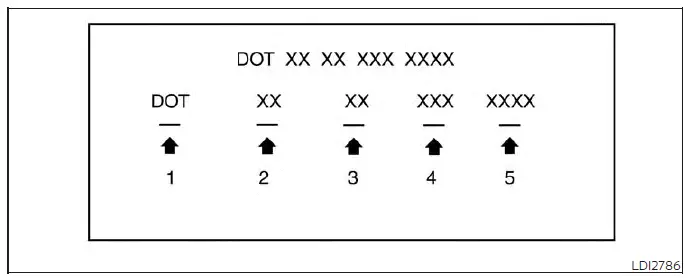
Example (Type A) (if so equipped)
- TIN (Tire Identification Number) for a new tire (example: DOT XX XX XXX XXXX)
1. DOT: The official abbreviation signifying compliance with the "Department Of Transportation" safety standards. This symbol can be positioned above, below, or to the left or right of the main Tire Identification Number sequence.
2. Two-digit code: The unique manufacturer's plant identification mark.
3. Two-digit code: The internal tire size designation code.
4. Three-digit code: An optional tire type code used by the manufacturer.
5. Four numbers: These digits represent the exact manufacturing work week and calendar year the tire was built.
For example, the numbers 3103 indicate that the tire was produced during the 31st week of the year 2003.
If these specific date digits happen to be missing from the visible side, inspect the opposite sidewall of the tire.
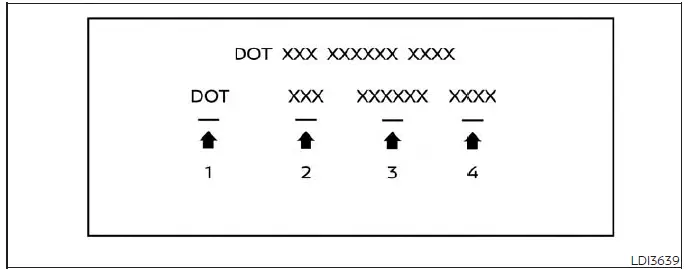
Example (Type B) (if so equipped)
- TIN (Tire Identification Number) for a new tire (example: DOT XXX XXXXXX XXXX)
1. DOT: The abbreviation for "Department Of Transportation". This symbol may be located above, below, or to the left of the Tire Identification Number sequence.
2. Three-digit code: The manufacturer's identification mark.
3. Six-digit code: A descriptive code utilized to identify significant structural and performance characteristics of the tire.
4. Four numbers: These digits designate the manufacturing week and year the tire was constructed.
For instance, the numbers 3103 signify the 31st week of 2003.
- Tire ply composition and material
This section indicates the total number of layers or plies of rubber-coated fabric built into the tire carcass. Tire manufacturers are also required by law to list the specific raw materials utilized within the tire construction, which commonly include steel, nylon, polyester, and other compounds.
- Maximum permissible inflation pressure
This figure represents the absolute greatest amount of cold air pressure that should ever be put into the tire. You must never exceed this maximum permissible inflation pressure rating during maintenance.
- Maximum load rating
This number indicates the maximum weight load capacity measured in kilograms and pounds that can be safely carried by the tire. When replacing the original tires on your Nissan Versa, always select replacement tires that feature the exact same load rating as the factory-installed equipment.
- Term of "tubeless" or "tube type"
This marking clearly indicates whether the tire requires a separate inner tube ("tube type") or operates independently without one ("tubeless").
- The word "radial"
The word "radial" is stamped explicitly on the sidewall if the tire features internal radial ply construction.
- Manufacturer or brand name
The official commercial name of the tire manufacturer or brand is prominently displayed.
Other Tire-related Terminology
In addition to the many technical terms defined throughout this manual section, the Intended Outboard Sidewall is designated as (1) the specific sidewall that contains decorative whitewall striping, bears raised white lettering, or features manufacturer, brand, or model name moldings that stand higher or deeper than the opposing sidewall, or (2) the outward-facing sidewall of an asymmetrical tire design that possesses a specific directional orientation and must always face outward toward the exterior when mounted onto the vehicle wheels.
Types of tires Nissan Versa sedan
WARNING
- When changing or replacing tires on your Nissan Versa, always make certain that all four mounted tires are of the exact same type (meaning Summer, All Season, or Snow categories) and internal structural construction. An authorized NISSAN dealer can provide expert assistance and information regarding optimal tire type, proper sizing, speed ratings, and local product availability.
- Replacement tires purchased aftermarket may sometimes feature a lower maximum speed rating than the factory-equipped original tires, and they might not match the ultimate potential top speed capability of the vehicle. You should never exceed the established maximum speed rating limit marked on the tire sidewall.
- Replacing your original tires with alternative tires not specifically specified or approved by NISSAN could adversely affect the proper operation and calibration of the low tire pressure warning system (TPMS).
- Always use tires of the exact same type, size, brand, construction, and tread pattern across all four wheels. Failure to adhere to this requirement may result in an undesirable rolling circumference difference between the tires on the front and rear axles, which can cause the Vehicle Dynamic Control (VDC) system to malfunction, potentially resulting in personal injury or death, excessive uneven tire wear, and serious mechanical damage to the transmission and differential gear components.
- For comprehensive additional information regarding tire selection, care, and safety, refer to the "Important Tire Safety Information" (for US vehicles) or "Tire Safety Information" (for Canadian vehicles) sections located inside your official Warranty Information Booklet.
All season tires
NISSAN factory-specifies All Season tires on certain Nissan Versa models to provide reliable, balanced driving performance throughout the entire year, including during light snowy and icy winter road conditions.
All Season tires are easily identified by the text "ALL SEASON" and/or the mud and snow designation "M&S" stamped directly onto the tire sidewall.
Dedicated snow tires provide superior winter snow traction compared to standard All Season tires and may prove to be much more appropriate if you reside in regions with severe winter weather.
Summer tires
NISSAN specifies specialized summer tires on select models to deliver superior cornering and braking performance on dry asphalt and warm roads. However, summer tire traction performance is substantially reduced when operating in freezing temperatures, snow, and ice.
True summer tires do not feature the "M&S" traction rating stamp on their sidewalls.
If you plan to operate your Nissan Versa in snowy or icy winter environments, NISSAN strongly recommends equipping dedicated SNOW tires or ALL SEASON tires across all four wheel positions.
Snow tires
If specialized winter snow tires are required for your local driving conditions, it is critical to select tires that are completely equivalent in physical size, load index, and construction rating to the original factory equipment tires. Failing to do so can severely compromise the handling dynamics and safety of your vehicle.
As a general rule, winter snow tires feature lower maximum speed ratings than factory-equipped standard tires and may not match the potential maximum top speed capability of your vehicle. Never exceed the maximum speed rating specified for the snow tire.
If you decide to install specialized winter snow tires on your Nissan Versa, they must match in the exact same size, brand, structural construction, and tread pattern across all four wheel positions to ensure stable handling.
For enhanced traction and grip when driving on heavily iced winter roads, metal-studded tires may be utilized. However, please note that certain U.S. states and Canadian provinces strictly prohibit or restrict their use.
Always check local, state, and provincial laws and regulations thoroughly before installing studded tires on your vehicle. Keep in mind that the braking, skid resistance, and overall traction capabilities of studded snow tires when driven on clear wet or dry asphalt surfaces may actually be poorer than those of non-studded snow tires.
Tire chains
The use of tire chains may be prohibited depending on your geographical location and local municipal ordinances. Always verify local regulations before attempting to install tire chains. When installing tire chains on your Nissan Versa, make certain that they are of the correct proper size for your specific vehicle tires and are fitted precisely according to the chain manufacturer's step-by-step instructions. Use exclusively SAE class "S" chains. Class "S" chains are specifically designed and approved for use on modern passenger vehicles that feature restricted clearance between the tires and vehicle components.
Vehicles engineered to utilize Class "S" chains are built to accommodate the strict minimum clearance margins between the tire sidewall and the closest vehicle suspension or body parts required for winter traction devices such as tire chains or cables. These precise minimum clearances are calculated and determined using the original factory-equipped tire dimensions.
Using alternative types of chains may cause physical damage to your Nissan Versa. Always utilize appropriate chain tensioners when recommended by the tire chain manufacturer to ensure a snug, secure fit. Any loose end links of the tire chain must be securely fastened down or trimmed to prevent the risk of violent whipping action damage to the vehicle fenders or underbody. Whenever possible, avoid fully loading your vehicle with passengers and heavy cargo when driving with tire chains attached. In addition, always drive at a safely reduced speed. Failing to follow these precautions may cause vehicle damage and/or adversely affect your handling and driving performance.
Tire chains must be installed exclusively on the front drive wheels and must never be installed on the rear wheels of your Nissan Versa.
Never attempt to install tire chains onto a TEMPORARY USE ONLY compact spare tire.
Do not use or drive with tire chains on clear dry roads. Operating a vehicle with chains mounted in such conditions can cause severe mechanical stress and damage to various drive mechanisms due to overstressing.
NOTE:
Please note that traditional tire chains are not permitted or approved for use on vehicle configurations equipped with 17-inch wheels.
Changing wheels and tires Nissan Versa N18
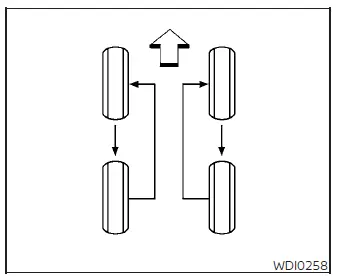
To help ensure uniform tread wear and maximize the lifespan of your rubber, NISSAN recommends rotating the tires on your Nissan Versa every 7,500 miles (12,000 km).
As soon as possible after servicing, securely tighten all wheel nuts to the specified torque value utilizing a calibrated torque wrench.
Wheel nut tightening torque: 83 ft-lb (113 N·m)
The wheel lug nuts must be kept tightly secured to these precise factory specifications at all times to prevent loosening.
It is strongly recommended that your vehicle wheel nuts be checked and retightened to specification at each scheduled tire rotation interval.
WARNING
- Immediately after rotating the tires on your Nissan Versa, always check and adjust the tire inflation pressures to the recommended levels.
- Always retighten the wheel lug nuts after the vehicle has been driven for an initial distance of 600 miles (1,000 km). This retightening procedure is also mandatory whenever a wheel has been removed, such as in the case of repairing a flat tire.
- Do not include the temporary compact spare tire in your regular tire rotation pattern.
- For comprehensive additional information regarding tire maintenance and safety, refer to the "Important Tire Safety Information" (for US models) or "Tire Safety Information" (for Canadian models) sections located in your official Warranty Information Booklet.
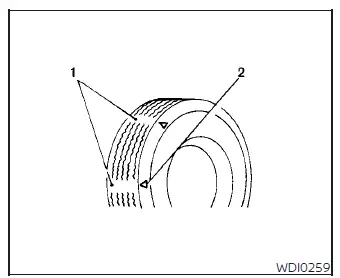
Tire wear and damage
- Wear indicator
- Location mark
WARNING
- Tires should be periodically inspected thoroughly for abnormal tread wear, structural cracking, sidewall bulging, or sharp objects embedded in the tread. If excessive wear, cracks, deep bulges, or deep cuts are found, the affected tire(s) should be replaced immediately.
- The original factory tires feature built-in tread wear indicators. When these wear indicator bars become flush and visible across the tread grooves, the tire(s) must be replaced without delay.
- Pneumatic tires naturally degrade over time due to environmental aging and active use. Have any tires, including the spare tire, that are over 6 years old inspected closely by a qualified automotive technician, because structural tire damage may not always be obvious from a visual exterior check. Replace aging tires as necessary to prevent sudden tire failure and possible personal injury.
- Improper service, inflation, or repair of the compact spare tire may result in serious personal injury. If it is ever necessary to service or repair the spare tire, it is recommended that you visit an authorized NISSAN dealer for this specialized service.
- For additional information regarding tire inspections, refer to "Important Tire Safety Information" (US) or "Tire Safety Information" (Canada) in your Warranty Information Booklet.
Replacing wheels and tires
When replacing a worn tire on your Nissan Versa, always use a replacement tire that features the exact same physical size, tread design pattern, speed rating, and load-carrying capacity as originally equipped from the factory.
WARNING
- The use of replacement tires other than those officially recommended, or the mixed use of tires featuring different brands, internal constructions (such as bias, bias-belted, or radial designs), or mismatched tread patterns, can severely and adversely affect the ride comfort, braking stability, handling dynamics, Vehicle Dynamic Control (VDC) system operation, ground clearance, body-to-tire clearance, tire chain clearance, speedometer calibration, headlight beam aim, and bumper height. Some of these dangerous side effects may lead to a loss of vehicle control and could result in serious personal injury or accidents.
- If your Nissan Versa was originally equipped with four matching tires and you are only replacing two of the four tires, you must install the new tires exclusively on the rear axle. Placing brand-new tires on the front axle may cause a sudden loss of vehicle control in certain slippery or wet driving conditions, leading to an accident and severe personal injury.
- If the vehicle wheels are replaced for any reason, always replace them with new wheels that possess the exact same offset dimension and rim specifications.
Wheels featuring an incorrect offset dimension can cause premature and uneven tire wear, degrade overall vehicle handling characteristics, adversely affect the Vehicle Dynamic Control (VDC) system, and/or cause physical mechanical interference with the brake discs or brake drums on your Nissan Versa. Such harmful interference can lead directly to decreased braking efficiency, brake fade, and/or accelerated brake pad wear.
If excessive or abnormal tire wear is discovered during an inspection, it is recommended that all four tires be replaced simultaneously with new tires of the exact same size, manufacturer brand, structural construction, and tread pattern. Furthermore, the tire inflation pressures and vehicle wheel alignment should be thoroughly checked and corrected as necessary to protect your investment. It is recommended that you visit an authorized NISSAN dealer for this professional alignment and service.
Wheel balance
Unbalanced wheels can severely affect overall vehicle handling stability, ride comfort, and tire tread life on your Nissan Versa. Even with normal, regular driving use, vehicle wheels can naturally fall out of dynamic balance over time. Therefore, they should be professionally balanced as required.
Wheel balance service should always be performed with the wheels removed completely from the vehicle.
Attempting to perform direct spin balancing of the wheels while they are still mounted on the vehicle could lead to expensive mechanical damage to the suspension or drivetrain.
- For additional information regarding tire and wheel maintenance, refer to "Important Tire Safety Information" (US) or "Tire Safety Information" (Canada) in your Warranty Information Booklet.
Care of wheels
- Wash the wheels thoroughly whenever you wash your Nissan Versa to maintain their clean factory appearance and protect the finish.
- Make sure to clean the inner backside of the wheels whenever a wheel is removed for service or when the undercarriage and underside of the vehicle are washed.
- Never use harsh abrasive cleaners, steel wool, or strong chemical solvents when washing and detailing your wheels.
- Inspect the metal wheel rims regularly for any signs of physical dents, bends, or surface corrosion. Such structural damage can cause a gradual loss of tire pressure or create a poor air seal at the tire bead interface.
- NISSAN recommends applying a protective coat of quality automotive wax to the road wheels to guard against corrosive road salt in geographic areas where salt is heavily used during the winter months.
Spare tire (TEMPORARY USE ONLY spare tire)
When operating your Nissan Versa with a replacement wheel that lacks an active TPMS sensor—such as when utilizing the compact spare tire—the Tire Pressure Monitoring System will not function.
Please observe all of the following critical precautions carefully if the TEMPORARY USE ONLY compact spare tire must be installed. Failing to follow these safety guidelines could result in severe vehicle damage or lead to a serious accident:
WARNING
- The compact spare tire is intended strictly for emergency use only. It should always be replaced with a standard full-size road tire at the very first available opportunity to avoid potential tire wear imbalances or differential gear damage.
- Drive with extreme caution and reduced speed while the TEMPORARY USE ONLY spare tire is installed on your Nissan Versa. Avoid sharp, aggressive turns, sudden lane changes, and abrupt braking maneuvers while driving.
- Periodically check the inflation pressure of your spare tire. Always maintain the pressure of the TEMPORARY USE ONLY spare tire at the specified 60 psi (420 kPa, 4.2 bar) level.
- When driving with the TEMPORARY USE ONLY spare tire installed, never operate the vehicle at speeds exceeding 50 mph (80 km/h).
- When driving on winter roads covered with deep snow or ice, the TEMPORARY USE ONLY spare tire should ideally be mounted on the rear non-drive wheels, while a standard full-size original tire should be used on the front drive wheels to maintain proper traction.
- The tread rubber compound of the TEMPORARY USE ONLY spare tire will wear down at a significantly faster rate than standard road tires. Replace the spare tire immediately as soon as the built-in tread wear indicator bars become exposed and visible.
- Never attempt to use the compact spare tire from your Nissan Versa on any other vehicle.
- Never install or use more than one temporary spare tire on the vehicle at the exact same time.
- Do not attempt to tow a trailer of any kind when the TEMPORARY USE ONLY spare tire is installed on your vehicle.
CAUTION
- Never attempt to install tire snow chains onto a TEMPORARY USE ONLY compact spare tire. Tire chains will not fit properly over the smaller dimensions and may cause physical damage to the vehicle body and suspension.
- Because the TEMPORARY USE ONLY spare tire has a smaller overall diameter than your original factory tire, the vehicle's ground clearance is noticeably reduced. To avoid scraping or damaging the underside of your Nissan Versa, do not drive over high obstacles, speed bumps, or rocks. In addition, do not drive the vehicle through an automated commercial car wash, as the reduced clearance may cause components to catch and suffer damage.