
Vehicle load capacity
Do not exceed the load limit of your vehicle shown as “The combined weight of occupants and cargo” on the Tire and Loading Information label. Do not exceed the number of occupants shown as “Seating Capacity” on the Tire and Loading Information label.
To get “the combined weight of occupants and cargo”, add the weight of all occupants, then add the total luggage weight. Examples are shown in the following illustration.
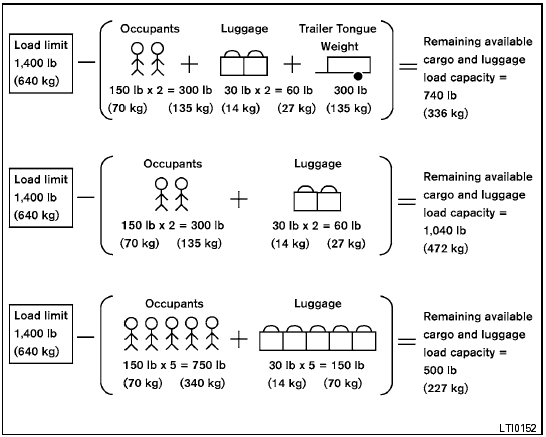
Example
Steps for determining correct load limit
1. Locate the statement “The combined weight of occupants and cargo should never exceed XXX kg or XXX lbs” on your vehicle’s placard.
2. Determine the combined weight of the driver and passengers that will be riding in your vehicle.
3. Subtract the combined weight of the driver and passengers from XXX kg or XXX lbs.
4. The resulting figure equals the available amount of cargo and luggage load capacity. For example, if the XXX amount equals 1400 lbs. and there will be five 150 lb. passengers in your vehicle, the amount of available cargo and luggage load capacity is 650 lbs. (1400-750 (5 X 150) = 650 lbs) or (640-340 (5 X 70) = 300 kg.).
5. Determine the combined weight of luggage and cargo being loaded on the vehicle. That weight may not safely exceed the available cargo and luggage load capacity calculated in Step 4.
6. If your vehicle will be towing a trailer, load from your trailer will be transferred to your vehicle. Consult this manual to determine how this reduces the available cargo and luggage load capacity of your vehicle.
Before driving a loaded vehicle, confirm that you do not exceed the Gross Vehicle Weight Rating (GVWR) or the Gross Axle Weight Rating (GAWR) for your vehicle.
See “Measurement of weights” later in this section.
Also check tires for proper inflation pressures.
See the Tire and Loading Information label.
See also:
Features & Pricing
Starting at $30,690 for a 2010 Maxima and increasing to $30,810 for a 2011,
the Maxima falls right between the Taurus ($25,170 to start, similarly equipped
for $27,370) and Avalon ($32,445 to star ...
Regulatory Information
FCC Regulatory information
CAUTION: To maintain compliance with
FCCs RF exposure guidelines, use only the
supplied antenna. Unauthorized antenna,
modification, or attachments could damage
th ...
Locking doors
Locking doors
1. Place the ignition switch in the LOCK position.
(Remove the key if any key is in the
ignition switch.)
2. Close all doors.
3. Push any door handle request switch 1
while ca ...