


Nissan Versa: In case of emergency - Towing your vehicle
Whenever you need to tow your Nissan Versa, all applicable state, provincial, and local regulations governing vehicle towing must be strictly observed and followed. Utilizing incorrect towing equipment or improper towing methods can cause severe structural or mechanical damage to your vehicle.
Comprehensive towing instructions and technical guidelines are readily available from any authorized NISSAN dealer. Professional local towing operators are generally well-acquainted with the relevant legal requirements and proper recovery procedures for your car. To guarantee proper handling and prevent accidental damage during transport, NISSAN strongly recommends entrusting the task to a professional commercial tow service operator. It is highly advisable to have the service operator carefully read and adhere to the following safety precautions:
WARNING
- Never ride inside a vehicle while it is actively being towed by another vehicle or tow truck.
- Never get underneath your Nissan Versa after it has been elevated or supported by a tow truck.
CAUTION
- When preparing for towing, always verify that the transmission, axles, steering system, and entire powertrain are in sound working condition.
If any of these components are damaged or malfunctioning, specialized towing dollies or a flatbed tow truck must be utilized.
- Always attach heavy-duty safety chains securely before initiating any towing procedure.
Towing recommended by NISSAN
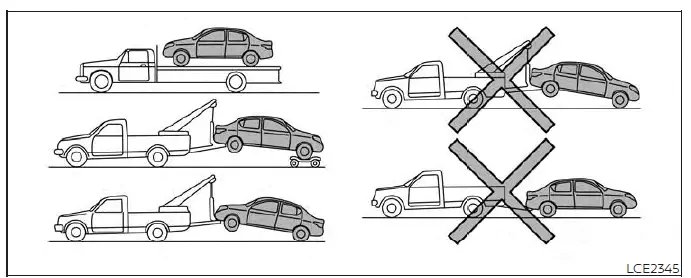
Two-Wheel Drive models with Continuously Variable Transmission (CVT)
NISSAN highly recommends that your Nissan Versa be towed with the driving front wheels completely off the ground, or alternatively, transported securely on a professional flatbed truck as illustrated.
CAUTION
- Never tow Continuously Variable Transmission (CVT) models with the front wheels resting directly on the ground or with all four wheels rolling on the ground (whether moving forward or backward), as this will cause serious, highly expensive internal damage to the transmission.
If it is strictly necessary to tow the vehicle with the rear wheels raised off the ground, you must always use proper towing dollies underneath the front wheels.
- When towing Continuously Variable Transmission (CVT) models with the rear wheels on the ground or resting on towing dollies:
- Place the ignition switch in the OFF position, and secure the steering wheel firmly in a straight-ahead position using a sturdy rope or a specialized steering lock device.
Never attempt to lock or secure the steering wheel by placing the ignition switch in the LOCK position, as this can break or damage the internal steering lock mechanism on models equipped with one.
- Place the ignition switch in the OFF position, and secure the steering wheel firmly in a straight-ahead position using a sturdy rope or a specialized steering lock device.
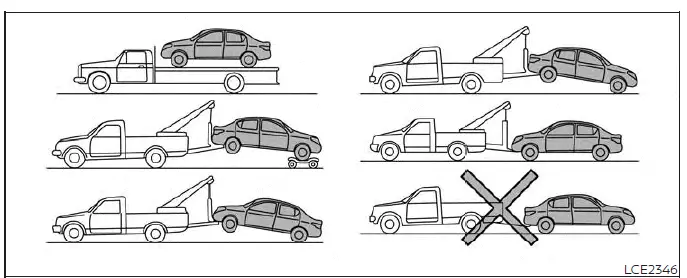
Two-Wheel Drive models with manual transmission
NISSAN recommends that proper towing dollies be used when towing your Nissan Versa, or that the vehicle be placed entirely on a flatbed tow truck as illustrated.
If you must use a traditional pull-behind tow truck setup, ensure the manual transmission is shifted completely into N (Neutral).
Your vehicle towing speed should never exceed 60 mph (97 km/h) under any circumstances while the vehicle is being towed.
After every 500 miles of continuous towing, you must stop, start the engine, and let it idle with the manual transmission in N (Neutral) for at least two minutes. Omitting this mandatory idle period after every 500 miles of towing can lead to premature wear or severe damage to internal transmission components.
CAUTION
Failure to strictly follow these towing guidelines can result in extensive and costly transmission damage.
- If you are forced to tow manual transmission models with the rear wheels rolling on the ground (without using towing dollies) or with all four wheels on the ground:
- Always make sure the parking brake is completely released.
- Move the transmission shift lever firmly into the N (Neutral) position.
- Strictly observe the following maximum speed and distance limitations designated exclusively for manual transmission models:
Speed Limit: Below 60 mph (97 km/h)
Distance Limit: Less than 500 miles (805 km)
When towing your Nissan Versa over long distances or at sustained speeds in excess of 60 mph (97 km/h), it is necessary to remove the propeller shaft before towing begins to prevent severe internal damage to the transmission. For additional technical information and professional assistance, it is recommended that you visit an authorized NISSAN dealer.
Vehicle recovery (freeing a stuck vehicle)
WARNING
To completely avoid vehicle structural damage, serious personal injury, or fatal accidents when recovering a stuck vehicle:
- Always contact a professional commercial towing service to safely recover your Nissan Versa if you have any doubts, questions, or concerns regarding the proper recovery procedure.
- Heavy-duty tow chains or recovery cables must be attached exclusively to the main structural frame members of the vehicle.
- Never use the standard vehicle tie-down loops to pull, tow, or free a stuck vehicle.
- Only utilize recovery devices and straps specifically engineered and rated for vehicle recovery purposes, and always follow the manufacturer's operational instructions carefully.
- Always pull the recovery device straight out forward from the front of the vehicle.
Never attempt to pull at an acute angle or sideways.
- Carefully route all recovery straps and lines so they do not touch or rub against any painted body parts or mechanical components of the vehicle except at the designated attachment point.
If your Nissan Versa becomes stuck in deep sand, snow, thick mud, or similar slippery materials, utilize a certified tow strap or other specialized device designed explicitly for vehicle recovery operations. Always adhere closely to the manufacturer's safety instructions provided for the recovery equipment.
Rocking a stuck vehicle
WARNING
- Always stand well clear of a stuck vehicle while recovery maneuvers are being attempted.
- Never spin your tires at a high rotational speed.
Doing so could cause the tires to overheat and explode, resulting in severe personal injury. Critical mechanical parts of your vehicle could also dangerously overheat and suffer permanent damage.
If your Nissan Versa is stuck in sand, snow, or mud, execute the following systematic procedure to free it:
1. Turn off the Vehicle Dynamic Control (VDC) system temporarily.
2. Make doubly sure that the entire area directly in front of and behind the vehicle is completely clear of people, obstacles, and debris.
3. Turn the steering wheel back and forth between the far right and far left to clear away packed snow, mud, or sand from around the front tires.
4. Slowly and gently rock your Nissan Versa forward and backward to build momentum.
- Shift smoothly back and forth between R (Reverse) and D (Drive) for Continuously Variable Transmission models, or between 1st (Low) and R (Reverse) for manual transmission models.
- Apply the accelerator pedal as lightly and minimally as possible just to maintain the gentle rocking motion.
- Always release the accelerator pedal completely before shifting between R (Reverse) and D (Drive) on Continuously Variable Transmission models, or between 1st (Low) and R (Reverse) on manual transmission models, to protect the drivetrain.
- Never allow the tires to spin at speeds exceeding 35 mph (55 km/h) on the speedometer.
5. If your vehicle cannot be freed successfully after a few careful tries, stop immediately and contact a professional towing service to extract your vehicle safely.