
Continuously Variable Transmission (CVT) (if so equipped)
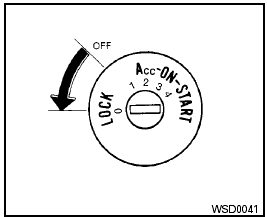
Without Intelligent Key
The ignition lock is designed so that the ignition switch cannot be turned to the LOCK position until the shift selector is moved to the P (Park) position.
● When moving the ignition switch to the LOCK position, make sure the shift selector is in the P (Park) position.
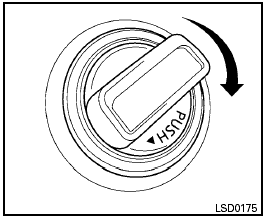
With Intelligent Key
● When removing the key from the ignition switch, make sure the shift selector is in the P (Park) position.
When the ignition switch cannot be turned to the LOCK position.
1. Shift the shift selector to the P (Park) position.
2. Turn the ignition switch slightly in the ON direction.
3. Turn the ignition switch to the LOCK position.
4. Remove the key if it is inserted in the ignition switch.
If the ignition switch is turned to the LOCK position, the shift selector cannot be moved from the P (Park) position.
The shift selector can be moved if the ignition switch is placed in the ON position and the foot brake pedal is depressed.
There is an OFF position between the LOCK and ACC positions. The OFF position is indicated by a “1” on the key cylinder.
See also:
Air conditioning system refrigerant and lubricant recommendations
The air conditioning system in your
NISSAN vehicle must be charged with the
refrigerant HFC-134a (R-134a) and the oil,
NISSAN A/C system oil Type S or the exact
equivalents.
The use of an ...
Brakes
If the brakes do not operate properly, have the
brakes checked by a NISSAN dealer.
Self-adjusting brakes
Your vehicle is equipped with self-adjusting
brakes.
The front and rear disc-type brakes ...
INFO
- If you are controlling the telephone system
by voice command for the first time or do not
know the appropriate voice command,
speak “Help”. The system announces the
available commands.
...