


Nissan Versa: Safety-Seats, seat belts and supplemental restraint system - Seat belts
- Precautions on seat belt usage
- Seat belt warning light and chime
- Three-point type seat belt with retractor
- Seat belt extenders
Precautions on seat belt usage Nissan Versa 2020
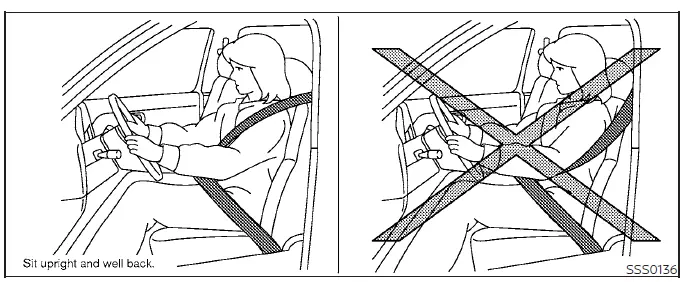
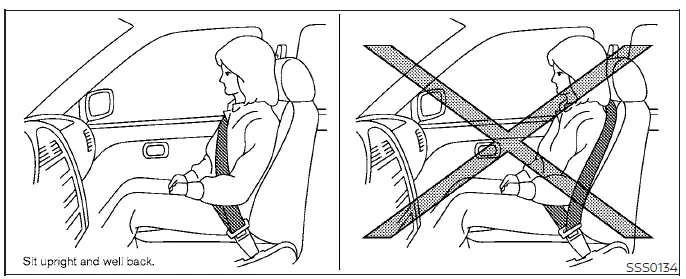
When you wear your seat belt properly adjusted, sit fully upright, and remain well back in your seat with both feet flat on the floor, your chances of being injured or killed in a collision, as well as the overall severity of any resulting injuries, may be significantly reduced. NISSAN strongly encourages you and all of your passengers to buckle up every single time you drive your Nissan Versa, regardless of whether your specific seating position is equipped with a supplemental air bag safety system.
In fact, most U.S. states and Canadian provinces or territories have strict laws specifying that seat belts must be worn at all times by all occupants whenever a vehicle is being driven on public roads.
WARNING
- Every single person who drives or rides as a passenger in this vehicle must use a properly fastened seat belt at all times. For optimal safety, children should always be seated in the rear seats and secured in an appropriate, age-matching child restraint system.
WARNING
- The seat belt must be carefully adjusted to a snug, secure fit. Failure to achieve a proper fit may seriously reduce the protective effectiveness of the entire occupant restraint system and dramatically increase the risk or severity of physical injury in an accident. Severe, life-threatening injury or death can easily occur if the seat belt is worn incorrectly or left unfastened.
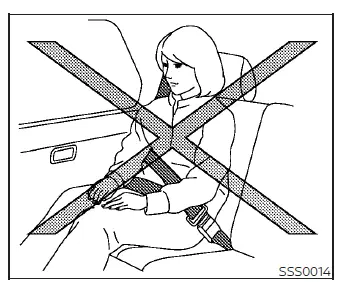
WARNING
- Always route the shoulder belt directly over your shoulder and diagonally across your chest.
Never place the shoulder belt behind your back, under your arm, or tightly across your neck.
The belt webbing should be positioned comfortably away from your face and neck, yet securely situated so that it does not slip or fall off the edge of your shoulder.
- Position the lap belt as low and snug as possible AROUND THE HIPS, NOT THE WAIST area. A lap belt worn too high on the abdomen could dramatically increase the risk of severe internal organ injuries in the event of an accident.
- Always make sure the seat belt tongue is pushed firmly and securely fastened into the corresponding buckle designed for that specific seating position in your Nissan Versa.
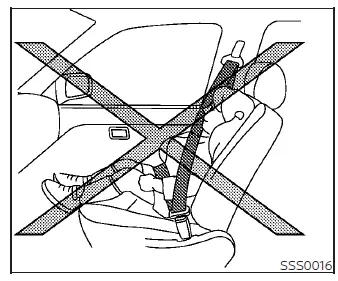
- Do not wear the seat belt inside out, inverted, or twisted. A twisted webbing restricts the belt's ability to distribute crash forces evenly, which may seriously reduce its protective effectiveness.
- Never allow more than one person to share or use the same seat belt at any given time, as this defeats the system's ability to protect either individual.
- Never carry more occupants in your Nissan Versa than there are functional seat belts provided at the designated seating positions.
- If the seat belt warning light remains illuminated continuously or the warning chime continues to sound while the ignition is turned ON with all passenger doors fully closed and all occupant seat belts securely buckled, it may indicate a system malfunction. Have the seat belt electrical systems checked as soon as possible. It is highly recommended that you visit an authorized NISSAN dealer for this specialized diagnostic service.
- No aftermarket changes, modifications, or physical alterations should ever be made to any part of the seat belt system. For example, do not modify the seat belt webbing, add custom padding materials, or install aftermarket clips and devices that may alter the factory seat belt routing, retracting mechanism, or tension. Doing so may severely compromise the automatic operation of the seat belt system. Modifying or tampering with the seat belt safety system may lead to failure during a crash and result in serious personal injury.
- Once the integrated seat belt pretensioner system has been activated during a collision, the affected seat belt assemblies cannot be reused and must be completely replaced along with the retractor mechanism. To ensure safety standards are fully restored in your Nissan Versa, it is strongly recommended that you visit an authorized NISSAN dealer for this critical replacement service.
- All structural seat belt assemblies, including the automatic retractors, buckles, anchors, and physical attaching hardware, must be thoroughly inspected after any collision.
It is recommended that you visit an authorized NISSAN dealer to have this safety inspection performed professionally.
NISSAN strongly recommends that all seat belt assemblies in use during a collision be replaced with new parts, unless the impact was extremely minor and the belts show absolutely no signs of physical damage while continuing to operate smoothly and properly. Seat belt assemblies that were not in active use during a collision should also be carefully inspected and immediately replaced if any signs of structural damage, webbing wear, or improper mechanical operation are observed.
- All child restraint systems (car seats) and their corresponding latching and attaching hardware must be fully inspected following any vehicle collision. Always strictly follow the safety seat manufacturer's specific inspection instructions and recommended replacement guidelines.
The child restraints must be completely replaced if any damage, stress fractures, or structural compromises are discovered.
Seat belt warning light and chime Nissan Versa 3rd Gen
The driver, front passenger, and rear seats inside the Nissan Versa are equipped with an advanced, multi-zone seat belt reminder function. If your vehicle is configured with this enhanced seat belt safety reminder system, both a highly visible digital icon on the dashboard and an audible chime will activate if any front seat belt remains unbuckled. This system begins monitoring occupant status at speeds of approximately 9 mph (15 km/h) or higher, triggerable under the following precise cabin conditions:
- If the driver's seat belt is not securely clicked into its buckle when the vehicle is in operation.
- If the front passenger's seat belt is not buckled and the system detects that the front seat is occupied by a passenger for more than 7 seconds after the ignition switch has been placed in the ON position.
- If the front passenger's seat belt is not buckled and objects, cargo, or other external downward forces on the seat cushion shift the seat belt reminder classification to Occupied.
The flashing red seat belt warning light will continue to pulse rapidly on the Nissan Versa display cluster under the conditions outlined above until the corresponding seat belt is fully pulled out and securely latched.
The accompanying acoustic warning chime will sound continuously for approximately 90 seconds, or it will cease immediately when one of the following safety conditions is met:
- The previously unbuckled driver or front passenger seat belt is securely locked into its matching buckle.
- The sensitive pressure weight sensors in the front passenger seat no longer register that the seat is occupied.
- The vehicle's ignition is completely turned off.
Because the passenger seat sensor relies on precise weight thresholds, certain everyday cabin situations might accidentally trigger the seat belt reminder light and warning chime on your Nissan Versa, even if there is no actual human passenger sitting there. These scenarios include:
- Heavy parcels, grocery bags, backpacks, or luggage placed directly on the front passenger seat cushion.
- A passenger or rear occupant pushing, pulling, or placing heavy weight on the front passenger seat frame.
- An object, such as a bottle or box, wedged tightly under the front passenger seat, affecting the weight sensors.
- An object stuffed or wedged between the passenger seat cushion and the center console, or between the seat cushion and the inner door panel.
- Heavy coats, bags, or items hanging on the seat headrest stalks or packed tightly into the rear seatback pocket.
- An improperly installed child restraint system, or large cargo item in the rear row, pressing hard against the rear plastic of the front seatback.
NOTE:
In addition to front seat monitoring, the rear seats in your Nissan Versa may also be equipped with an active rear seat belt warning message that displays on the vehicle information screen to track passenger status in the back row.
Pregnant women
NISSAN highly recommends that pregnant women wear their seat belts at all times during travel. To ensure safety for both mother and child in the Nissan Versa, the belt must be adjusted to a snug fit, positioning the lap belt portion as low as physically possible around the hips, never across the waist or abdomen. Position the diagonal shoulder belt comfortably over the shoulder and across the center of the chest. Never route any part of the lap/shoulder belt directly over your abdominal area. It is best practice to contact your personal physician for specific, individualized medical driving recommendations.
Injured persons
NISSAN recommends that injured persons also use their seat belts to prevent further trauma during unexpected maneuvers. If you have specific physical limitations or injuries, check with your doctor to obtain specialized advice on wearing seat belts comfortably and safely inside your Nissan Versa.
Three-point type seat belt with retractor Nissan Versa N18
WARNING
- Every person who drives or rides in this vehicle must use a three-point type seat belt at all times. To maximize protection inside the Nissan Versa, children should always be properly buckled up in the rear seats and secured in an appropriate child restraint system suitable for their age and weight.
- Do not ride in a moving vehicle when the seatback is in a reclined position. This can be highly dangerous. When reclined, the shoulder belt will not be properly positioned against your body. In the event of an accident, you could be forcefully thrown into the belt and receive severe neck or other serious personal injuries.
You could also easily slide underneath the lap belt portion, leading to severe, life-threatening internal abdominal injuries.
- For the most effective passenger protection when the vehicle is in motion, the seat must be positioned upright. Always sit well back, straight and upright in the seat with both feet flat on the floor, and adjust the seat belt properly to secure your body.
- Do not allow children to play with or handle the seat belts. Most seating positions inside the Nissan Versa are equipped with Automatic Locking Retractor (ALR) mode seat belts. If a seat belt becomes wrapped around a child's neck and the ALR mode is accidentally activated, the child can be seriously injured or killed as the seat belt retracts and tightens. This dangerous situation can occur even if the vehicle is parked and the engine is turned off.
Immediately unbuckle the seat belt buckle to release the child. If the seat belt cannot be unbuckled normally or is already unbuckled but remains tightly wrapped, quickly release the child by cutting the seat belt webbing with a suitable tool, such as a sharp knife or scissors.
Fastening the seat belts
1. Properly adjust your seat position. Slide the seat forward or backward, and adjust the seatback to an upright position before pulling the seat belt webbing.
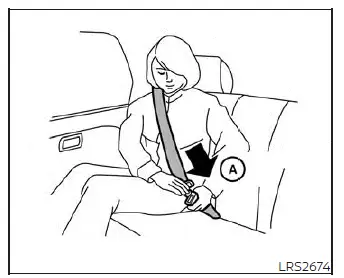
2. Slowly and smoothly pull the seat belt out of the retractor housing and insert the metal tongue into the designated buckle A until you hear and feel the latch firmly engage.
- The internal seat belt retractor in your Nissan Versa is specifically designed to lock during a sudden stop, rapid deceleration, or on physical impact. A slow, steady pulling motion permits the seat belt webbing to move freely, allowing you some comfortable freedom of movement while seated.
- If the seat belt becomes stuck and cannot be pulled from its fully retracted position, firmly pull the belt outward once and release it to clear the lock mechanism.
Then, smoothly pull the belt webbing out of the retractor to secure yourself.
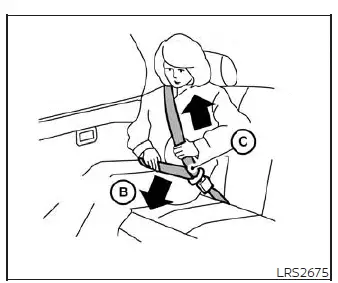
3. Position the lap belt portion as low and snug as possible on the hips B as shown in the diagram, ensuring it does not ride up across your waist.
4. Pull the diagonal shoulder belt portion upward toward the retractor housing to take up any extra slack C. Always be sure the shoulder belt is routed properly over your shoulder and across the center of your chest.
The front passenger seat and all of the rear seating positions' three-point seat belts are equipped with two distinct operational safety modes:
- Emergency Locking Retractor (ELR)
- Automatic Locking Retractor (ALR)
The standard ELR mode allows the seat belt to extend and retract smoothly, offering the driver and passengers a comfortable range of movement under normal driving conditions. The ELR automatically locks the seat belt in place when the Nissan Versa slows down rapidly, experiences hard braking, or during certain collision impacts.
The ALR mode, also widely referred to as the child restraint mode, locks the seat belt mechanism firmly in place to facilitate the secure and stable installation of a child safety seat inside your Nissan Versa.
When this ALR mode is actively engaged, the seat belt webbing is locked and cannot be pulled out or extended any further. To release the lock and pull the belt out again, you must detach the seat belt tongue from the buckle and allow the webbing to retract back into the housing completely. Once the seat belt fully retracts, the system automatically switches back to the standard, occupant-friendly ELR mode.
The specialized ALR mode should be utilized strictly during child restraint installation. For normal seat belt usage by adult occupants or older children, the ALR mode must not be activated. If it is accidentally engaged during regular use, it will cause increasingly uncomfortable, tight seat belt tension as the passenger moves. Furthermore, it can potentially alter the diagnostic weight classification and operation of the front passenger air bag safety system in your Nissan Versa.
WARNING
When fastening the passenger seat belts, always ensure that the adjustable rear seatbacks of your Nissan Versa are completely locked and securely fixed in their upright, latched positions. If the seatbacks are not completely secured, rear passengers or heavy cargo could slide forward, potentially leading to severe injuries during a sudden stop or collision.
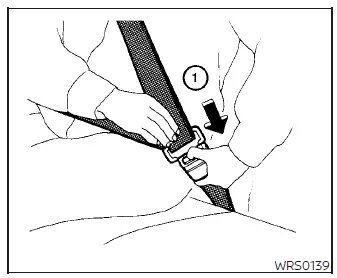
Unfastening the seat belts
To unfasten the seat belt, simply press the red release button located on the face of the buckle housing 1. Once released, guide the tongue as the seat belt automatically and smoothly retracts back into its side wall housing.
Checking seat belt operation
The integrated seat belt retractors in your Nissan Versa are engineered with advanced safety mechanisms designed to lock the seat belt webbing and restrict movement using two separate trigger methods:
- When the seat belt webbing is pulled or jerked rapidly outward from the retractor housing.
- When the vehicle undergoes rapid deceleration, hard braking, or experiences a sudden impact.
To confirm the functional integrity of your safety restraints and drive with peace of mind, you can perform a quick check of the retractor lock operation using this simple method:
- Firmly grasp the shoulder belt webbing and pull it forward quickly in one rapid motion. The internal locking mechanism of your Nissan Versa retractor should engage immediately, stopping the belt from extending any further.
If the retractor mechanism fails to lock instantly during this manual check, have the restraint system inspected immediately. It is highly recommended that you visit an authorized NISSAN dealer to obtain professional diagnostic service or to receive comprehensive advice regarding your safety restraint systems.
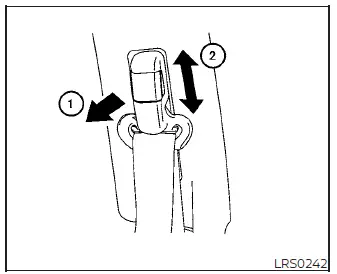
Shoulder belt height adjustment (front seats)
To ensure maximum safety, the height of the front shoulder belt anchors should always be adjusted to the ideal position matching your physical build. To make this adjustment, pull out or squeeze the release button 1 and slide the shoulder belt anchor vertically 2 to your desired position so that the webbing passes directly over the center of your shoulder. The belt must remain positioned comfortably away from your face and neck, but secure enough that it does not slip or fall off your outer shoulder. Release the adjustment button to lock the anchor firmly into one of the preset height positions inside your Nissan Versa.
WARNING
- Following any height adjustment, always release the button and pull firmly on the anchor assembly to try and slide it up and down. This quick check ensures that the shoulder belt anchor is securely locked in its track and will not slip during a collision.
- The height of the shoulder belt anchor must be properly adjusted to the position that best fits your body. Failure to properly position this anchor can severely decrease the protective capabilities of the entire restraint system, greatly increasing the risk or severity of injuries in an accident.
Seat belt extenders Nissan Versa N18
If, because of body size or your preferred driving position, it is not possible to properly fit and securely fasten the standard three-point lap/shoulder belt, an approved seat belt extender that is fully compatible with the factory-installed seat belts of your Nissan Versa is available for purchase. This genuine accessory adds approximately 8 in (200 mm) of length to the restraint, providing a safer and more comfortable fit, and can be utilized for either the driver or the front passenger seating position.
To ensure complete system compatibility and to verify that you receive the correct part engineered specifically for your vehicle model, it is recommended that you visit an authorized NISSAN dealer for assistance with purchasing and verifying a seat belt extender if one is required for your daily travels.
WARNING
- Only genuine NISSAN seat belt extenders, manufactured by the exact same company that produced your vehicle's original equipment safety belts, must be paired with the restraint system of your Nissan Versa. Using third-party, universal, or unapproved extenders can compromise the structural integrity of the latch mechanism during a collision.
- Adults and children who are physically capable of using the standard, factory-installed seat belt should never use an extender. Such unnecessary use alters the geometry of the lap and shoulder belt routing, which could result in serious, life-threatening personal injury in the event of an accident.
- Never use seat belt extenders to install or secure child restraints or booster seats. If a child restraint is not secured directly to the vehicle's factory anchors or standard seat belt webbing, the seat cannot be held stable, and the child could be seriously injured or killed in a collision or during a sudden, violent stop.
Seat belt maintenance
- To preserve the structural strength and appearance of the seat belt webbing in your Nissan Versa, clean it by applying a mild soap solution, warm water, or any specialized solution officially recommended for cleaning automotive upholstery or carpet. After washing, wipe down the wet areas with a clean microfiber cloth and allow the pulled-out seat belts to air-dry completely in the shade. To prevent mold, mildew, and corrosion within the internal spring mechanism, do not allow the seat belts to retract back into the trim panels until they are fully dry.
- Over time, if dust, oils, or dirt build up in the upper shoulder belt guide of the seat belt anchors, the safety belts may begin to retract slowly or get stuck. Periodically wipe the inner surfaces of the shoulder belt guide loop with a clean, dry cloth to remove any residue and restore smooth retraction.
- It is highly recommended to periodically check the entire physical condition of the seat belts and their associated metal hardware components—such as the locking buckles, metal tongues, automatic retractors, flexible mounting wires, and floor anchors—to verify that they work properly and latch smoothly. If you discover any loose mounting bolts, physical deterioration, cuts, fraying, or other structural damage on the polyester webbing, the entire seat belt assembly of your Nissan Versa should be replaced immediately by a professional technician to maintain cabin safety.