
Parking brake
WARNING
● Be sure the parking brake is fully released before driving. Failure to do so can cause brake failure and lead to an accident.
● Do not release the parking brake from outside the vehicle.
● Do not use the shift selector in place of the parking brake. When parking, be sure the parking brake is fully engaged.
● Do not leave children unattended in a vehicle. They could release the parking brake and cause an accident.
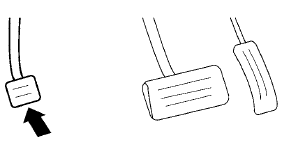
Type A
To engage: Type A, firmly depress the parking brake. Type B, pull the lever up A . To release:
1. Firmly apply the foot brake.
2. Manual transmission models:
Place the shift selector in the N (Neutral) position.
CVT models:
Move the shift selector to the P (Park) position.
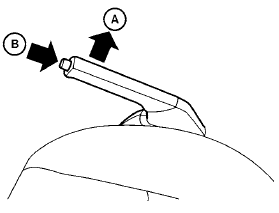
Type B
3. Type A, firmly depress the parking brake pedal and it will release. Type B, while pulling up on the parking brake lever slightly, push the button and lower completely B .
4. Before driving, be sure the brake warning light goes out.
See also:
NISSAN Intelligent Key™ door buzzer
The Intelligent Key door buzzer sounds if the
Intelligent Key is left inside the vehicle when
locking the doors. When the buzzer sounds, be
sure to check both the vehicle and the Intelligent
Key. ...
LATCH lower anchor location
LATCH lower anchor location
The LATCH anchors are located at the rear of
the seat cushion near the seatback. A label is
attached to the seatback to help you locate the
LATCH anchors. ...
Phone settings
To set up the Bluetooth Hands-Free Phone
System to your preferred settings, press the SETTING
button on the instrument panel and select
the “Phone” key on the display.
Edit Vehicle Phonebook ...