
Battery
- Keep the battery surface clean and dry.
Clean the battery with a solution of baking soda and water.
- Make certain the terminal connections are clean and securely tightened.
- If the vehicle is not to be used for 30 days or longer, disconnect the negative (−) battery terminal cable to prevent discharging it.

- Do not expose the battery to flames or electrical sparks. Hydrogen gas generated by the battery is explosive.
Do not allow battery fluid to contact your skin, eyes, fabrics, or painted surfaces. After touching a battery or battery cap, do not touch or rub your eyes. Thoroughly wash your hands. If the acid contacts your eyes, skin or clothing, immediately flush with water for at least 15 minutes and seek medical attention.
- Do not operate the vehicle if the fluid in the battery is low. Low battery fluid can cause a higher load on the battery which can generate heat, reduce battery life, and in some cases lead to an explosion.
- When working on or near a battery, always wear suitable eye protection and remove all jewelry.
- Battery posts, terminals and related accessories contain lead and lead compounds. Wash hands after handling.
- Keep the battery out of the reach of children.
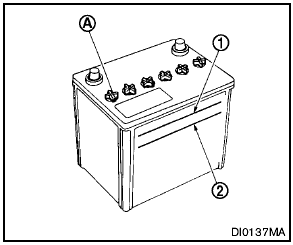
Check the fluid level in each cell. (Remove the battery cover if it is necessary.) It should be between the UPPER LEVEL 1 and LOWER LEVEL 2 lines.
If it is necessary to add fluid, add only distilled water to bring the level to the indicator in each filler opening. Do not overfill.
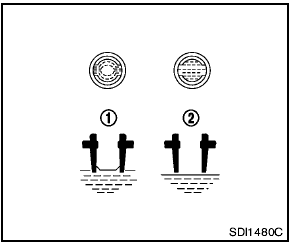
1. Remove the cell plugs A .
2. Add distilled water up to the UPPER LEVEL 1 line.
If the side of the battery is not clear, check the distilled water level by looking directly above the cell; the condition 1 indicates OK and the conditions 2 needs more to be added.
3. Tighten cell plugs A .
Vehicles operated in high temperatures or under severe conditions require frequent checks of the battery fluid level.
See also:
Tire pressures
● When towing a trailer, inflate the vehicle
tires to the recommended cold
tire pressure indicated on the Tire
and Loading Information label.
● Trailer tire condition, size, load ra ...
Fuses
Two types of fuses are used. Type (A) is used in
the fuse boxes in the engine compartment. Type
(B)- is used in the passenger compartment fuse
box.
Type A fuses are provided as spare fuses. ...
Engine coolant temperature gauge
Engine coolant temperature gauge
NOTE:
The ignition switch must be placed in the
ON position for the gauge to give a reading.
The gauge indicates the engine coolant temperature.
The engine ...